Vietnam’s healthcare story has, for the past decade, been told through beds and clinics: hospital construction, insurance expansion, and rising household health spending. A quieter and arguably more consequential shift is now underway one level up the supply chain, inside the factories that actually manufacture the medicine Vietnam consumes.
The pharmaceutical market is compounding at close to 8% a year, driven by an aging population and a chronic disease burden that now accounts for roughly four out of every five deaths nationwide. Yet domestic manufacturers still supply less than half the market by value, and only a small fraction of local factories meet the international certification standards that unlock export markets and premium hospital tenders. That gap between demand and manufacturing capability has become one of the more active M&A corridors in Vietnamese industry, culminating most recently in a Chinese-backed acquisition of a controlling stake in one of the country’s largest listed drugmakers.
The Scale of Vietnam’s Pharmaceutical Demand Growth
A Market Compounding Faster Than Its Factories Can Follow
Vietnam’s pharmaceutical market was valued at approximately USD 7.6 billion in 2024 and is on track to roughly double to around USD 12 billion by 2030, a compound annual growth rate of close to 8%. Some industry estimates place the market considerably higher once specialty and biologic therapies are included, but the direction is consistent across every major forecast: sustained, structural growth.
Two demographic forces sit behind the curve. Vietnam’s population is aging quickly, and non-communicable diseases, cardiovascular illness, diabetes, and cancer chief among them, now account for an estimated 77% to 80% of all deaths in the country. Prescription drugs have become the primary growth engine within the broader market, forecast to rise from roughly USD 4.9 billion in 2025 to close to USD 7.2 billion by 2030 on their own. A revised Law on Pharmacy, effective July 2025, has also streamlined drug registration and added incentives for manufacturers of advanced generics and biosimilars, removing some of the friction that previously slowed new product launches.
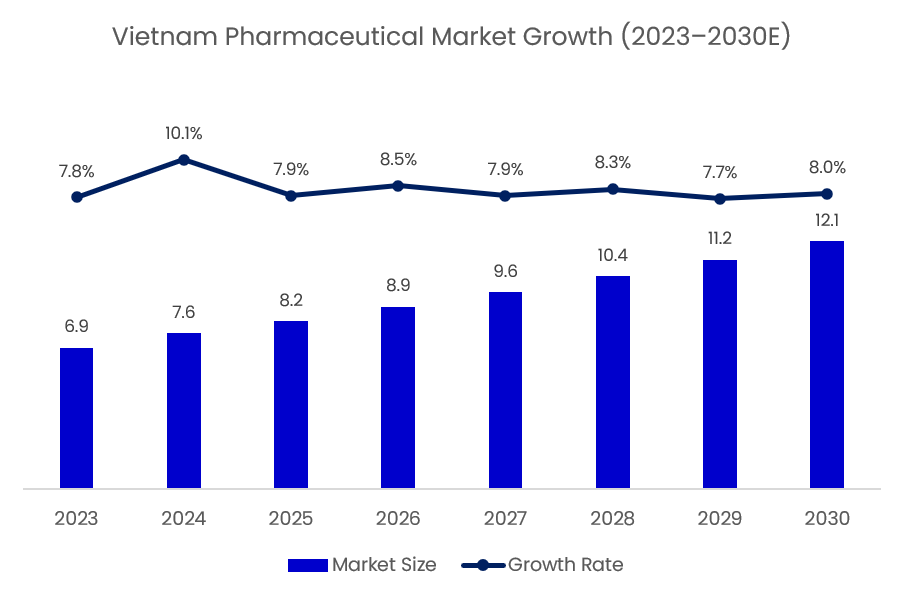
Figure 1. Vietnam pharmaceutical market size, 2023–2030E (USD billion). Historical data for 2023–2024 and illustrative projections for 2025–2030 based on an approximately 8% industry CAGR. Source: BMI (Fitch Solutions); U.S. International Trade Administration; author’s estimates.
The Import Dependency Vietnam Cannot Manufacture Its Way Out Of
Volume Self-Sufficiency Masks a Value Gap
On paper, Vietnam’s domestic industry looks reasonably self-sufficient: local manufacturers supply an estimated 53% to 60% of the medicines consumed by volume. The picture changes once value is measured instead of unit count. By value, domestic production covers only around 46% of the market, meaning the majority of what Vietnam spends on medicine still leaves the country as an import.
The gap is concentrated at the top of the value chain. Local manufacturers are strong in high-volume, low-complexity generics, antibiotics, common analgesics, and vitamins, but weak in patented originator drugs, biologics, and complex specialty therapies, almost all of which are imported. Active pharmaceutical ingredients tell a similar story: Vietnam currently produces only a small share of the raw inputs its own factories need, leaving the industry exposed to supply shocks of the kind seen when Chinese and Indian API plants shut down during COVID-19. This is the structural imbalance that gives foreign strategic buyers their opening: acquire the distribution networks and regulatory licenses that domestic players already hold, then upgrade the manufacturing behind them.
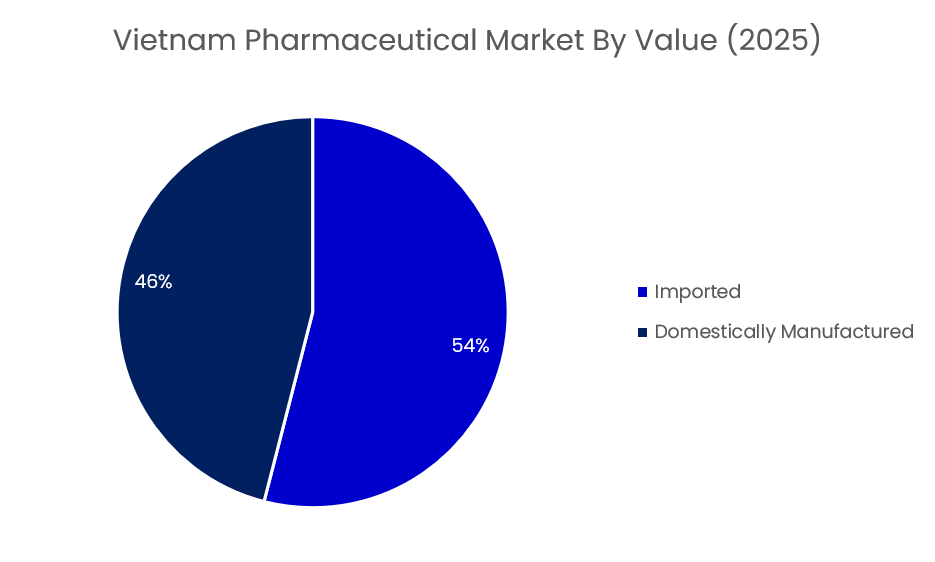
Figure 2. Vietnam pharmaceutical market by value, 2025. Imported pharmaceuticals account for approximately 54% of market value, while domestically manufactured products represent 46%. Source: Vietnam Ministry of Health; U.S. International Trade Administration (ITA).
Capital Has Already Started Moving
A Decade of Foreign Strategic Acquisitions in Listed Pharma

Foreign strategic investors have been quietly consolidating control of Vietnam’s listed pharmaceutical champions since the mid-2010s. Japan’s Taisho Pharmaceutical began building a stake in Hau Giang Pharmaceutical (DHG Pharma) in 2016 and had crossed 51% ownership by 2019. Abbott took a majority position in Domesco through a subsidiary around the same period. South Korea’s SK Group entered Imexpharm in 2020 and steadily increased its holding to a majority stake over the following years. Germany’s STADA absorbed Pymepharco entirely, delisting it from the Ho Chi Minh Stock Exchange once its stake approached 100%.
The most recent, and largest, transaction closed in early 2026: Lian SGP Holding, a Singapore-based entity wholly owned by China’s Livzon Pharmaceutical Group, acquired SK Group’s controlling stake in Imexpharm through a public tender offer worth roughly USD 227 million, taking its ownership to around 68%. It is among the largest disclosed pharmaceutical control transactions in Vietnam’s history and the clearest signal yet that Chinese strategic capital now views Vietnamese manufacturing platforms, not just distribution rights, as the prize.
The GMP Certification Divide
Regulatory Upgrade Is Becoming the Investment Filter
Vietnam has roughly 240 pharmaceutical manufacturing plants certified to WHO-GMP standards, more than 1.5 times the count a decade ago. But only around 29 to 31 of those facilities, roughly one in ten, also hold EU-GMP or an equivalent standard such as Japan-GMP or PIC/S. That certification gap matters commercially, not just technically. Under Circular 40/2025, drugs manufactured in EU-GMP or equivalent facilities receive preferential treatment in public hospital tenders, which still account for roughly three-quarters of total industry revenue through the ethical, or prescription, channel.
For an acquirer, an EU-GMP-certified line is close to a regulatory shortcut: it grants immediate access to the highest-value tender categories and to export markets that reject WHO-GMP-only product. That is precisely why certification status has become a central due diligence item in recent transactions, and why capital is flowing toward the small group of manufacturers, among them Imexpharm, DHG Pharma, and StellaPharm, that have already cleared the bar.
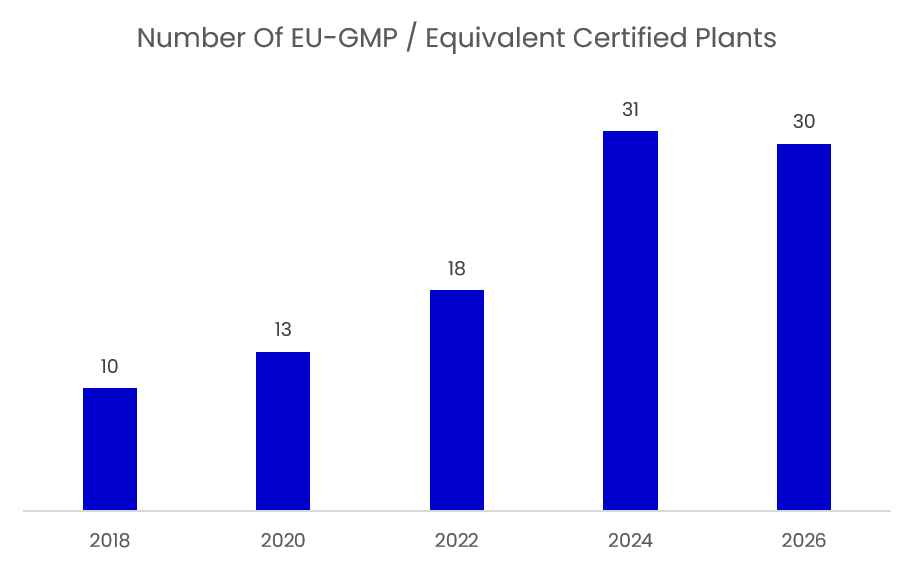
Figure 4. Number of Vietnamese pharmaceutical plants certified to EU-GMP or an equivalent international GMP standard, 2018–2026. Source: Vietnam Ministry of Health (Drug Administration of Vietnam); industry compilation.
The National Strategy Reshaping the Playing Field
Decision 1165 and the Push Toward 80% Self-Sufficiency
Vietnam’s government has attached explicit targets to this transition. Under Decision 1165/QD-TTg, the national pharmaceutical industry strategy through 2030, domestic manufacturers are expected to supply 80% of medicine demand by volume and 70% of the market by value within the decade, alongside a goal of producing 20% of required active pharmaceutical ingredients locally. The strategy also targets technology transfer for at least 100 brand-name drugs, vaccines, and biologics that Vietnam cannot currently produce, and aims to lift the country’s regulatory system to WHO Maturity Level 4, the tier associated with mature regional regulators.
These targets function as an implicit industrial policy for consolidation. Meeting an 80% volume and 70% value target from a starting point of roughly 46% value share requires either a large wave of brownfield capacity expansion, sustained foreign technology transfer, or both. Dedicated pharmaceutical industrial parks, including a large biopharma cluster planned for Thai Binh province, are being positioned as the physical infrastructure for that build-out.
Where the Institutional Opportunity Sits
Three Entry Points for Capital

For institutional investors, the opportunity extends well beyond buying a stake in an already-listed champion. Three entry points stand out. The first is brownfield GMP upgrade capital: mid-tier manufacturers with WHO-GMP status but no path to EU-GMP on their own are natural buyout or joint-venture targets, since the certification upgrade alone can materially reprice their tender access. The second is backward integration into active pharmaceutical ingredients and excipients, an area with almost no domestic supply and strong policy support under the national strategy. The third is distribution and market-access platforms, the wholesale and hospital-tender networks that give a foreign originator or biosimilar maker instant reach into Vietnam’s fragmented, 5,000-plus wholesaler and 62,000-plus retail outlet network without building one from scratch.
Industry estimates suggest as many as five to seven pharmaceutical and healthcare M&A deals worth over USD 100 million each could be announced in Vietnam during 2026 and 2027 alone, and that foreign-invested companies could control 40% to 50% of the domestic pharmaceutical market by 2030. Investor interest remains concentrated in a relatively small pool of EU-GMP-capable targets, which is likely to keep valuations for that specific group elevated relative to the broader sector.
Risks and Structural Headwinds
Free-Float Pressure, Registration Backlogs, and Tender Pricing
Three risks warrant close attention. The first is free-float and listing compliance risk: as foreign strategic shareholders push ownership of companies like Imexpharm and DHG Pharma toward 70% to 95%, both now face the possibility of falling below the minimum free-float thresholds required to remain listed, which could eventually force a delisting or a forced partial sell-down. The second is regulatory throughput: more than 3,500 pharmaceutical products remain stuck in Vietnam’s drug registration backlog, and only around 9% of new medicines launched globally over the past decade have reached the Vietnamese market, a slower approval cycle than most regional peers.
The third is tender pricing distortion. Vietnam’s public procurement system rewards the lowest bidder, and some competitors have adopted aggressive, near break-even pricing strategies to win volume, a practice that erodes margins across the industry and can undercut the economics of a newly upgraded, EU-GMP-certified facility that carries a higher cost base. Investors underwriting a GMP-upgrade thesis need to model tender pricing discipline explicitly rather than assume certification alone protects margin.
Closing the Gap: Vietnam’s Pharmaceutical Sector as an Institutional Theme

Vietnam’s pharmaceutical sector is a structural investment theme built on a demand curve that is growing roughly twice as fast as domestic manufacturing capability. Government policy has set explicit, dated targets to close that gap, and a decade of foreign strategic acquisitions, capped by a landmark 2026 Chinese-Korean control transaction, shows that capital already understands where the value sits: not in distribution alone, but in EU-GMP-certified manufacturing assets that unlock both hospital tenders and export markets.
For institutional investors, the most attractive opportunities extend beyond simply acquiring a listed manufacturer. Brownfield certification upgrades, API backward integration, and distribution platforms each offer a different risk and return profile, and each is directly supported by the same national strategy driving the sector’s consolidation.
Ultimately, Vietnam’s pharmaceutical reindustrialization is a story of closing a value gap: turning a market that is structurally reliant on imports into one capable of supplying, and eventually exporting, the medicines its own growing and aging population needs.
For deeper insights on capital markets, infrastructure investment, and emerging market opportunities across Southeast Asia, follow DealFlow for research-driven perspectives via LinkedIn or explore further analysis at DealFlow.sg.