
Many SME owners begin preparing for a transaction only after a buyer expresses interest. By that stage, the buyer may already influence the timetable, management is responding under pressure, and unresolved issues can quickly affect valuation, transaction structure and deal certainty.
Effective M&A readiness starts earlier. It is the process of making a company understandable, defensible and transferable before approaching the market. This goes beyond preparing an information memorandum or opening a data room. Management must clarify the transaction objective, improve financial information, resolve ownership and legal issues, reduce operational dependencies and demonstrate that performance can continue after ownership changes.
The purpose is not to present a flawless company. Buyers expect financial, commercial and operational risk. The purpose is to identify, quantify and explain material issues before they become reasons to reduce price, defer payment, delay completion or withdraw from the transaction.
M&A Readiness Is Becoming a Transaction Constraint

A profitable and growing business can still be difficult to acquire. Revenue may be expanding, but management reporting may be inconsistent. A valuable brand may support customer demand, but the intellectual property may be registered under the founder rather than the operating company. Major customers may have worked with the business for years, but relationships may remain informal and dependent on personal trust.
These weaknesses do not necessarily prevent a transaction, but they make the company harder to evaluate and transfer. The issue becomes more serious when they appear late in due diligence. A buyer that discovers inconsistent financial records, undocumented related-party transactions or unclear ownership may increase scrutiny across the entire company. What begins as an isolated issue can become a broader concern about control, information reliability and the credibility of the investment case.
In DealFlow’s framework, these concerns may be reflected through lower valuation, deferred consideration, earn-outs, additional indemnities or more demanding closing conditions. Early preparation gives the seller greater control over the process. Strong governance, reliable disclosure and clear accountability help buyers assess the company before uncertainty begins to affect price and transaction terms. (IFC)
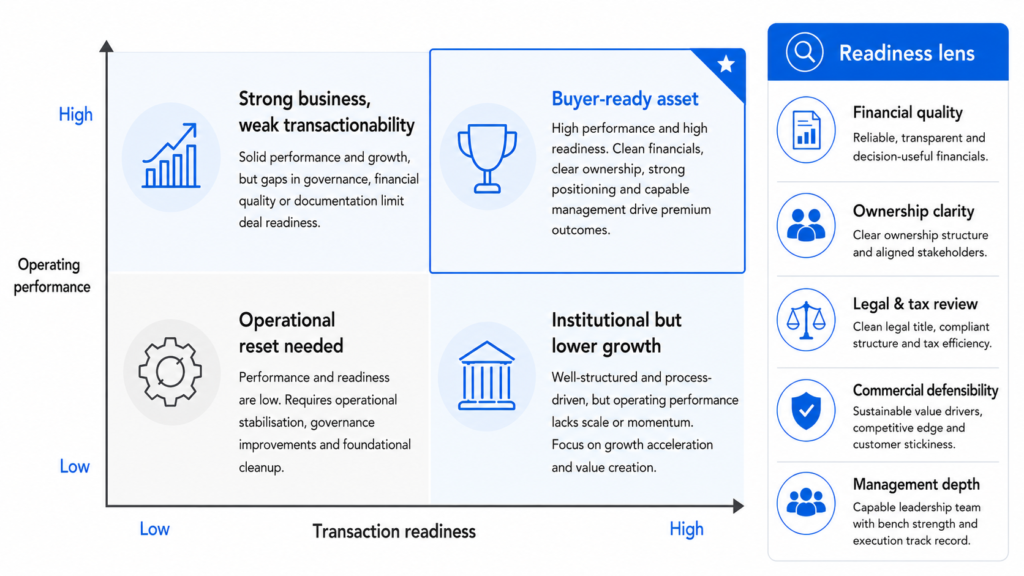
Figure 1: The SME transaction-readiness gap compares operating performance with the quality of financial reporting, governance, ownership transparency and organisational readiness. Source: DealFlow analysis based on IFC and the G20/OECD Principles of Corporate Governance.
Align Shareholders and Define the Transaction Strategy

The first stage of preparation is not financial modelling or document collection. It is establishing what shareholders want to achieve. A company seeking a full exit is pursuing a different outcome from one looking for partial liquidity, a minority investor, a strategic partner or growth capital. A founder seeking immediate liquidity may prioritise upfront cash, while an owner focused on regional expansion may value an investor that brings distribution, technology, management capability or access to new markets.
The transaction perimeter must also be defined clearly. Shareholders should agree on which entities, shares and assets are included, how much ownership is being offered, whether founders will remain involved after completion and what role they expect to play. They should also define the preferred timetable, acceptable transaction structures, restrictions on buyer type and the intended use of proceeds.
Without this alignment, the company may approach unsuitable investors or communicate inconsistent expectations during negotiations. For an owner-managed SME, governance practices must evolve as the company grows, brings in external capital and becomes more institutionally managed. In transaction preparation, this means clarifying shareholder roles, decision rights, succession expectations and accountability before approaching buyers.
The company’s positioning should then reflect the investor being targeted. Strategic buyers may focus on synergies, customer access, product expansion and operational integration. Financial investors may place greater weight on sustainable earnings, governance, scalability, cash generation and future exit potential. (IFC)
Build Decision-Grade Financial Information
Financial information is usually the first area in which an SME is tested as an institution rather than simply as an operating business. Many SMEs prepare accounts mainly for tax, statutory or banking purposes. These records may satisfy compliance requirements, but an investor needs a more detailed view of how the company creates value.
A buyer must understand where revenue comes from, which products and customers generate profit, how margins are changing, how much working capital the business consumes and how accounting profit converts into cash. A buyer-ready financial package should provide several years of consistent historical information together with current monthly performance. (IFRS Foundation)
Revenue should be analysed by customer, product, channel and geography. Gross margin, operating expenses, receivables, payables, inventory, debt and capital expenditure should be explained in sufficient detail. Even where an SME does not formally report under full IFRS, the underlying discipline remains relevant: revenue should be supported by commercial arrangements, evidence of delivery and consistently applied recognition practices.
Cash conversion requires the same level of attention. Management should explain why receivables or inventory have increased, how supplier terms affect liquidity and which capital expenditure is necessary to sustain current operations. A buyer that cannot reconcile reported earnings with operating cash generation is likely to apply greater caution when assessing value. (IFRS Foundation)
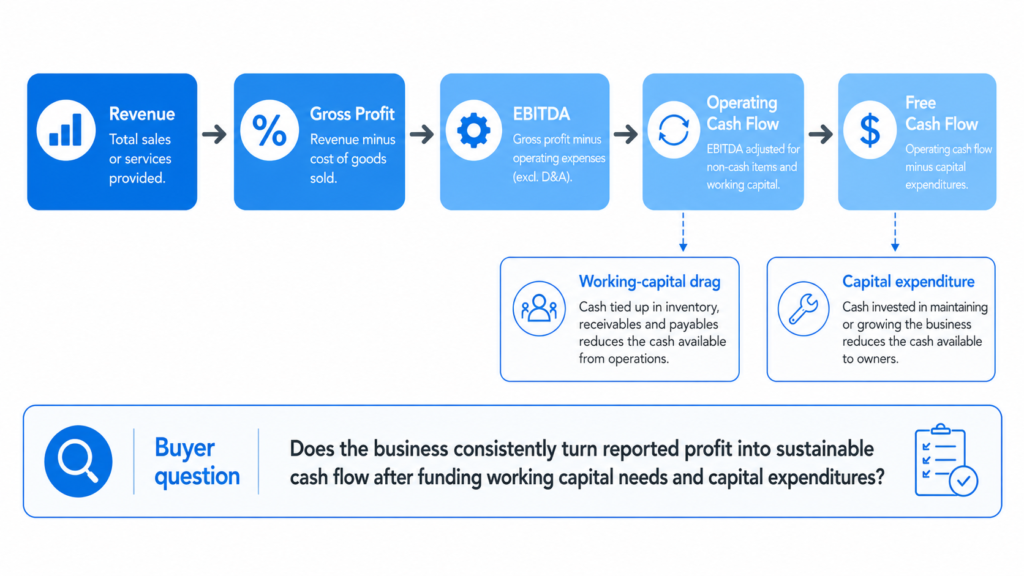
Figure 2: From reported revenue to cash generation shows the progression from revenue to gross profit, EBITDA, operating cash flow and free cash flow, including the effect of working-capital movements and capital expenditure. Source: DealFlow analysis based on IFRS 15 and IAS 7.
Convert Reported Profit into Sustainable Earnings
Reported EBITDA rarely represents the precise earnings base used in an M&A transaction. Founder-led companies may include personal expenses, related-party charges, unusual management compensation, exceptional professional fees, non-recurring income or costs connected to temporary events. Some of these items may be adjusted when calculating normalised EBITDA, but the adjustment process is often where seller expectations and buyer underwriting begin to diverge.
A genuine one-off restructuring expense may be added back where the programme has ended and the cost will not recur. Personal expenses paid through the company may be removed where they are clearly unrelated to operations. Related-party rent may be adjusted if it differs materially from market terms, while owner compensation may need to be replaced by the cost of professional management.
The analysis must also work in the opposite direction. Non-recurring income should be removed, and underinvestment in maintenance, staffing, technology or compliance may require a downward adjustment because a buyer will need to incur those costs after completion.
The strongest normalised earnings analysis is not the one that produces the highest EBITDA. It is the one that can withstand scrutiny. Management should explain changes in gross margin, customer and product mix, seasonality, bad debts, inventory provisions, capitalised expenses and required capital expenditure. Cash-flow analysis provides an important check because sustainable earnings must support the company’s operating cash requirements and investment needs, rather than existing only as an accounting measure. (IFRS Foundation)
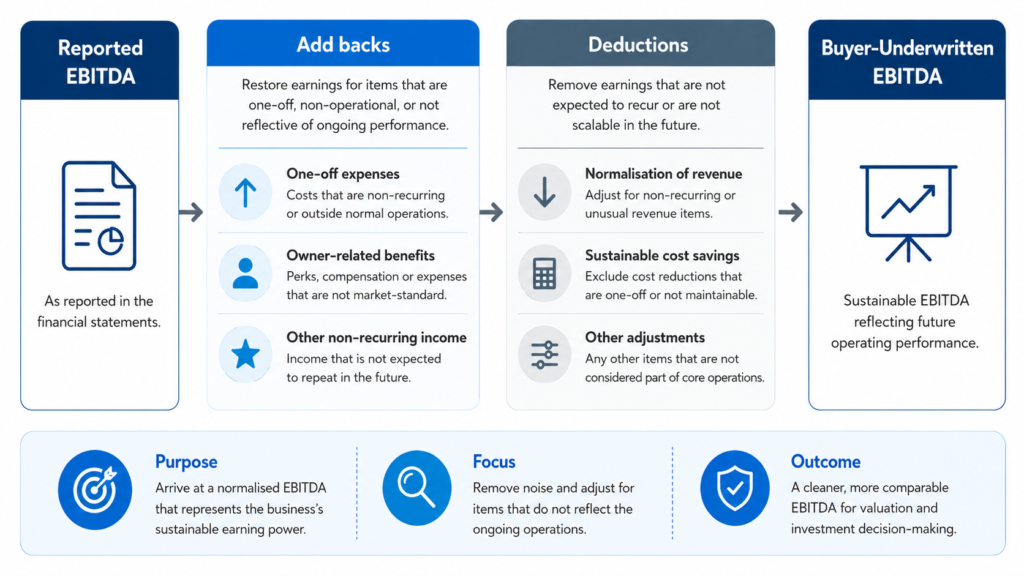
Figure 3: From reported EBITDA to buyer-underwritten EBITDA shows supported one-off add-backs, removal of exceptional income, market-based management costs and required recurring investment. Source: DealFlow analysis, with cash-conversion assessment informed by IAS 7.
Resolve Ownership, Legal, Tax and Related-Party Issues

Before valuing the company, the buyer must understand exactly what it is acquiring. This appears straightforward, but SMEs often develop faster than their legal and ownership structures. A brand may be registered under the founder, a subsidiary may hold an important licence but remain outside the transaction perimeter, or property may be used through an informal family arrangement. Historical share transfers may also be incomplete or inconsistent with the company’s internal capitalisation table.
Management should reconcile statutory shareholder records, share certificates, beneficial-ownership information and the group structure. The company should also review licences, regulatory approvals, material contracts, leases, intellectual property, employment arrangements, loans, security, guarantees, tax filings and pending disputes.
Incomplete information in these areas may create uncertainty over whether the operating company owns or controls the assets and rights required to continue the business after completion. That uncertainty can affect valuation, transaction protections and buyer appetite.
Related-party transactions require particular care. A business may lease property from a shareholder, purchase materials from a family-owned supplier, share employees with another group entity or rely on founder loans. These arrangements are not automatically problematic, but they should be documented, consistently reflected in the accounts and assessed on a standalone basis. The buyer needs to understand both the historical economics and the cost structure that will apply after closing. Outstanding tax assessments, unsupported incentives or inconsistent filings should similarly be identified early because they may affect completion conditions or final proceeds.
Prove Commercial Quality and Reduce Founder Dependence
Historical revenue attracts interest, but commercial quality determines buyer conviction. A buyer will examine whether customers are likely to remain, whether contracts can be transferred and whether the company can continue generating business after the founder reduces involvement. Customer concentration, retention, contract duration, recurring revenue, pricing power, product profitability, pipeline conversion and dependence on particular distribution channels all influence the value assigned to future earnings.
A company generating a large proportion of revenue from one customer may still be attractive where the relationship is long-standing, contractually secure and operationally embedded. Management must nevertheless explain the customer’s contribution to revenue and EBITDA, the likelihood of renewal and the plan for reducing concentration.
Forecasts should connect to measurable operating drivers such as signed contracts, visible pipeline, capacity expansion, pricing changes, new locations or historical conversion rates. A forecast based only on applying a percentage increase to the previous year is unlikely to create the same confidence.
Founder dependence can weaken an otherwise strong commercial model. In many SMEs, the founder controls customer relationships, approves major expenditures, manages procurement, negotiates financing and resolves operational problems. For M&A readiness, the company should share customer ownership with the wider team, clarify approval limits, develop second-line management and support important commercial relationships with formal contracts and repeatable processes. (IFC)
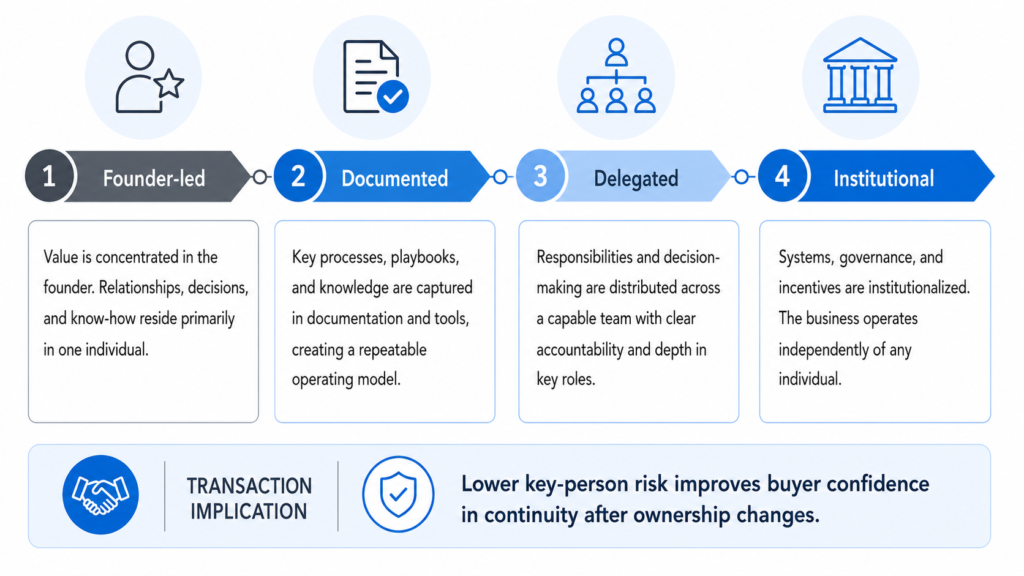
Figure 4: From founder dependence to institutional transferability shows the progression from founder-controlled relationships and decision-making to delegated management, documented processes, shared customer ownership and accountable governance. Source: DealFlow analysis based on the IFC SME Governance Guidebook.
Prepare the Data Room and Test the Business Before Launch

A data room is not only a place to store documents. It is evidence of the company’s internal discipline. If financial schedules conflict with statutory accounts, ownership records are incomplete or material contracts cannot be located, the issue is not merely administrative. It suggests weak control over information that management should already possess.
A buyer-ready data room should cover corporate records, financial information, tax matters, commercial contracts, legal documents, human resources, operations, technology, intellectual property, assets and forecasts. Documents should be clearly indexed, consistently named and reviewed before access is granted. Sensitive information can be released progressively as buyer commitment increases and confidentiality protections are confirmed. (OECD)
The important point is that management knows what information exists, where it is stored and how it supports the investment case. A focused 90-day programme can materially improve readiness. The first stage should confirm shareholder objectives and diagnose major financial, legal, commercial and organisational gaps. The second should address issues capable of resolution, such as unreconciled accounts, incomplete contracts and undocumented related-party arrangements. The third should prepare normalised earnings, forecasts, transaction materials and the data room. The final stage should test the company through mock due diligence and management rehearsals.
This timetable is a DealFlow framework rather than a regulatory requirement. Its purpose is to identify weaknesses before the buyer determines how those weaknesses will affect valuation and terms.
Closing Perspective: From Strong Business to Transferable Asset
M&A readiness for SMEs is ultimately about reducing uncertainty. Buyers expect financial, commercial and operational risk. What weakens a transaction is not the existence of risk, but the late discovery of issues that management should already understand. Once a buyer identifies a weakness during exclusivity, the seller has less time, fewer alternatives and limited control over how the risk is priced.
A well-prepared seller can explain how revenue is generated, why earnings are sustainable, how profit converts into cash and how the company will continue operating after ownership changes. Its ownership is clear, its documents are consistent, its management team is credible and its shareholders are aligned. Stronger governance does not remove business risk, but it can improve transparency, accountability, access to capital and the company’s ability to manage that risk.
Preparation does not guarantee a transaction. It does, however, improve the probability of attracting suitable buyers, protecting valuation and reaching completion on acceptable terms. For founders considering a partial sale, strategic investment or full exit, the best time to begin preparing is before the market process starts.
For deeper insights on M&A readiness, SME governance, transaction preparation, business transferability and emerging market opportunities, follow DealFlow for research-driven perspectives on M&A, fundraising and capital advisory via LinkedIn or explore further analysis at DealFlow.sg.