Southeast Asia’s private-credit opportunity is often discussed from the investor’s perspective: how quickly the asset class is growing, where traditional lenders leave financing gaps, and why alternative capital may matter to the region’s mid-market. For founders and CFOs, the more practical question is whether their companies can meet institutional lender requirements.
A company can be commercially successful without being credit-ready. It may have growing revenue and credible expansion opportunities, yet still struggle to secure institutional debt. The obstacle is often the gap between how the company operates internally and what a lender needs to analyse, document and monitor.
Private credit can offer greater flexibility than standard bank products, but not lower discipline. A lender may accept a more complex borrower, unconventional collateral or a bespoke repayment profile, but may require deeper due diligence, stronger information rights, covenants, security and a defined repayment path. DealFlow has separately examined Southeast Asia’s structural mid-market financing gap; this article focuses on borrower readiness.
Capital Is Growing, but Access Still Depends on the Borrower
Private credit has become a major part of the global financing system. The Alternative Credit Council and Houlihan Lokey estimate that global private-credit assets under management reached approximately US$3.5 trillion at the end of 2024, up 17% from the previous year. Corporate lending represented around 60% of current investments, while surveyed managers deployed an estimated US$592.8 billion during 2024. (AIMA / ACC and Houlihan Lokey)
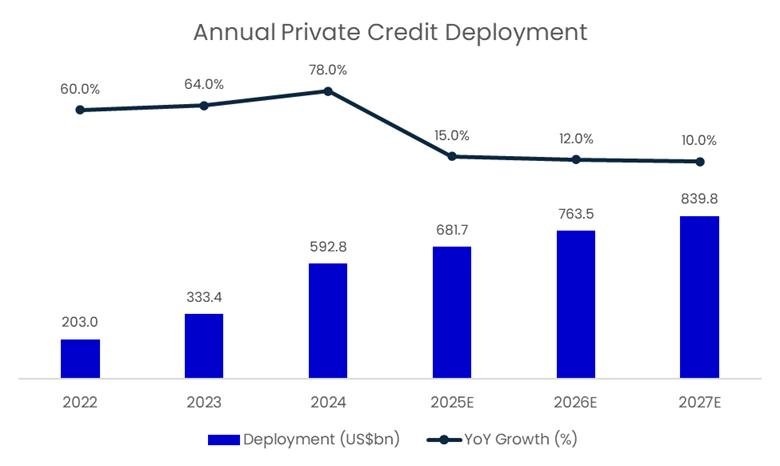
Figure 1: Global private credit AUM reached US$3.5 trillion in 2024, up 17% year on year. Corporate lending represented 60% of investments, with US$592.8 billion deployed. Source: Alternative Credit Council and Houlihan Lokey, Financing the Economy 2025.
Asia-Pacific remains smaller than the US and European markets, but its trajectory matters for Southeast Asian borrowers. AIMA and the Alternative Credit Council project APAC private-credit AUM to increase from US$59 billion in 2024 to US$92 billion by 2027, a 16% compound annual growth rate. Approximately 90% of transactions involve borrowers without private-equity sponsorship. (AIMA and Alternative Credit Council)
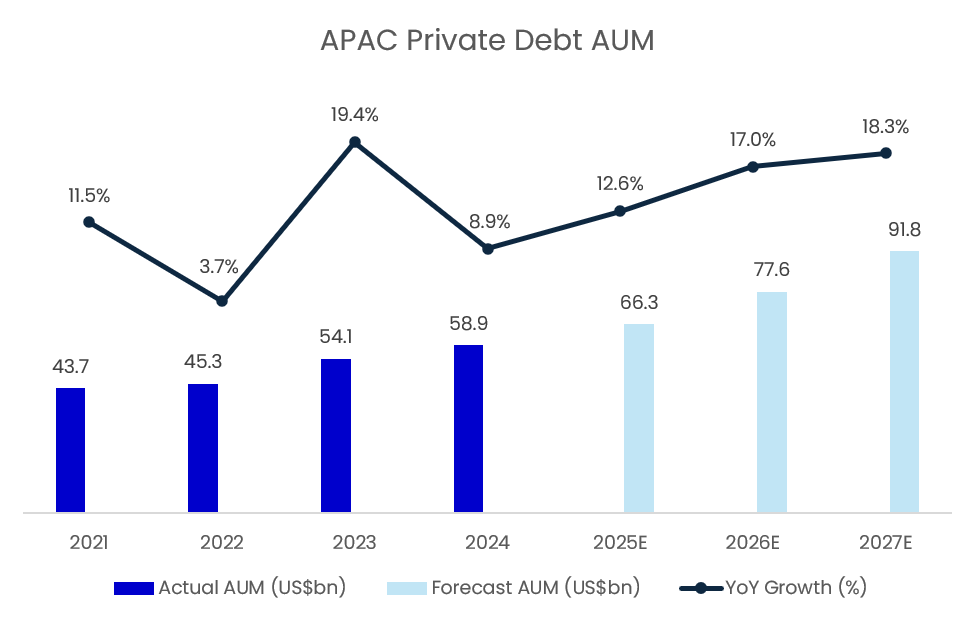
Figure 2: APAC private-credit AUM is projected to rise from US$59 billion in 2024 to US$92 billion by 2027, a 16% CAGR. Source: AIMA and Alternative Credit Council, Private Credit in Asia 2.0.
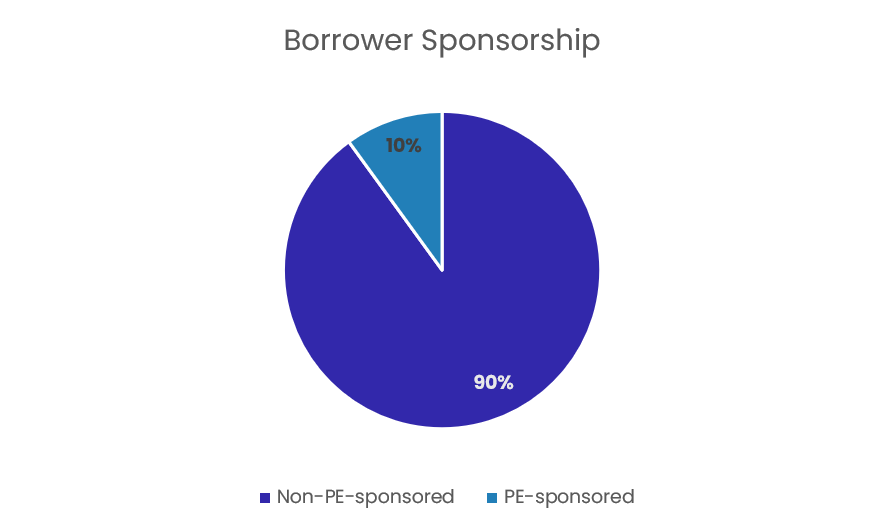
Figure 3: Around 90% of APAC private-credit transactions involve non-PE-sponsored borrowers, compared with roughly 10% involving PE-backed companies. Source: AIMA and Alternative Credit Council, Private Credit in Asia 2.0.
For borrowers, a larger pool of capital does not automatically mean easier financing. Institutional lenders still need to verify information, structure protection around identifiable risks and establish a credible route to repayment. The issue is whether the borrower can be assessed and monitored by an external credit committee.
A Financeable Business Is Not Necessarily Credit-Ready
Small and mid-sized companies play a major economic role but continue to face substantial financing constraints. IFC states that MSMEs represent more than 90% of firms worldwide and account, on average, for 70% of employment and 50% of GDP. Its estimates place the formal MSME financing gap at US$5.7 trillion, rising to US$8 trillion when informal enterprises are included, while 70% of MSMEs in emerging markets lack adequate financing. (IFC)
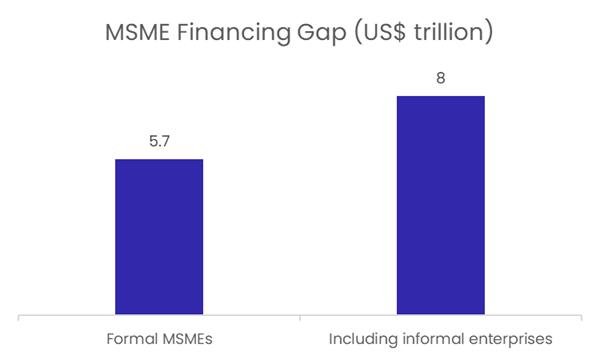
Figure 4: The MSME financing gap rises from US$5.7 trillion to US$8 trillion when informal enterprises are included, while 70% of emerging-market MSMEs lack adequate financing. Source: International Finance Corporation.
Part of this gap reflects information asymmetry. Management understands the company through daily operations, while a lender sees financial statements, bank records, contracts and forecasts. The business therefore needs to be translated into evidence that can withstand due diligence. Revenue should reconcile with the accounts, EBITDA should connect to cash generation, debt should be visible, and cash-generating entities should be linked to the borrower or security providers.
The World Bank identifies credit information, secured lending and insolvency frameworks as important parts of the infrastructure supporting SME finance. At company level, the same logic applies. A business may be financeable in economic substance but not yet credit-ready because its reporting, ownership structure, related-party arrangements or liabilities cannot be assessed efficiently. (World Bank)
The Financing Structure Must Match the Use of Proceeds
Private credit is most effective when it addresses a clearly defined financing requirement rather than providing undifferentiated growth capital. In Asia-Pacific, private-credit facilities are commonly structured as term loans for general corporate purposes, refinancing and bridge financing. Event-driven facilities for acquisitions and capital expenditure are also prevalent. For a lender, the central question is whether the facility amount, tenor and repayment terms are appropriate for how the borrower intends to use the capital.
The repayment structure should reflect when the financed activity is expected to generate cash. The AIMA and Alternative Credit Council report notes that bullet repayment remains common in APAC private credit, with the full principal repaid at maturity, while amortising structures are used where they better match the borrower’s cash-flow profile. Payment-in-kind interest may also be negotiated for bridge financing or growth-stage companies facing early cash-flow constraints, but it normally carries additional pricing because the lender receives cash later and takes greater risk.
A credit-ready borrower should therefore present more than a broad growth plan. It should explain exactly how the funds will be deployed, which operating milestones the financing will support, when the investment should begin producing cash and what alternative repayment options exist if the original plan is delayed. This is particularly important because temporary liquidity tools such as PIK interest, revolving facilities and restructurings can preserve cash in the near term while increasing debt and longer-term refinancing risk. The Financial Stability Board notes that repayment pressure becomes more severe after taxes, working-capital requirements and capital expenditure are taken into account.
Reporting, Ownership and Governance Shape Executability

In private credit, information quality is part of credit quality. A company that produces reliable monthly management accounts can be monitored more effectively than one with irregular reporting. The Financial Stability Board has identified borrower credit quality, valuation opacity and data limitations as key challenges as private credit expands.
A lender-ready company should provide consistent historical financial statements, management accounts, cash-flow information, a debt schedule and forecasts supported by operating assumptions. Revenue growth should be linked to measurable drivers, margins should reflect the cost structure, and capital expenditure should support the growth plan. Inconsistencies between audited statements, management reporting and fundraising materials can weaken lender confidence.
Ownership and governance are equally important. Lenders need to understand who controls the company, where operating assets sit, how cash moves through the group and whether subsidiaries can provide guarantees or security. Multiple SPVs are not inherently problematic, but their purpose and relationships should be clear before financing discussions begin.
Collateral Is Broader Than Real Estate, but Security Must Be Enforceable
Smaller businesses often struggle with conventional lending because much of their value lies outside traditional real-estate collateral. A company may own receivables, inventory, machinery, equipment or shares in operating subsidiaries while owning little land. The World Bank notes that movable assets represent a significant share of firms’ capital stock in developing economies, while smaller companies are less likely to own the fixed assets traditionally preferred by lenders. Stronger secured-transactions systems can therefore improve financing access. (World Bank)
Private credit can structure around a broader range of assets, including receivables, machinery, shares in subsidiaries, guarantees and contractual cash flows. However, security documents alone do not guarantee recovery value. Lenders must determine whether assets can be legally perfected and enforced if the borrower enters financial distress.
Cross-border Southeast Asian structures add complexity. A regional group may have a Singapore holding company with operating subsidiaries in multiple jurisdictions. A holding-company share pledge may not provide direct access to operating cash, while guarantees or receivables security may depend on local law. The key question is not only what collateral exists, but whether the lender can effectively enforce it under stress.
FX, Covenants and Capital Structure Must Work Together

A financing structure can become unsustainable even when the underlying company performs well if the debt currency does not match its cash flow. A business may earn revenue in local currency while borrowing in US or Singapore dollars. Currency depreciation increases debt-service costs without any deterioration in operating performance. Currency mismatch remains a recognized challenge in APAC private credit.
Borrowers should incorporate currency downside into financing models. Depreciation can reduce debt-service coverage, weaken covenant headroom and absorb cash intended for growth. Analysis should consider natural currency hedges, hedging costs and the level of depreciation the business can absorb before the financing structure becomes stressed.
The same principle applies to covenants. Leverage, liquidity and debt-service covenants should address specific risks while leaving headroom for normal volatility. Overly loose covenants provide little warning before deterioration, while overly restrictive covenants can trigger technical breaches. Strong financing structures align currency, cash flow, leverage, covenant headroom and repayment timing.
Banks and Private Credit Can Solve Different Financing Needs
For many Southeast Asian companies, the financing decision is not a binary choice between a bank and a private-credit fund. Banks often have advantages in working-capital facilities, payments, trade finance and local relationships, while private lenders may be better suited to acquisitions, shareholder transitions, regional expansion, bridge situations or transactions involving more complex collateral and repayment structures.
The relationship between banks and private credit is increasingly interconnected. The Financial Stability Board notes that banks and private-credit funds are linked through financing arrangements, revolving facilities and strategic partnerships. (Financial Stability Board)
A company can therefore combine funding sources rather than forcing one provider to finance the entire balance sheet. A bank may provide lower-cost working capital while private credit supports an acquisition or expansion programme, with equity absorbing the most junior risk. Such structures require coordination around security ranking, permitted debt, payment priority and enforcement arrangements. Private credit is most valuable when it fills a genuine structural gap while preserving a sustainable overall debt burden.
Credit Readiness Is Becoming a Competitive Advantage

Private-credit growth does not mean capital will automatically flow to every company unable to obtain a conventional bank loan. Institutional lenders provide flexible capital when they can understand the risk and identify a credible route to repayment. For Southeast Asian mid-market companies, that places the emphasis on preparation before lender outreach.
A credit-ready borrower combines visible cash generation, reliable reporting, transparent ownership and governance, meaningful collateral or structural protection, manageable currency exposure, realistic covenant capacity and a defined repayment path. Weak reporting can hide cash-flow deterioration, an unclear legal structure can weaken the security package, foreign-currency debt can reduce covenant headroom, and an aggressive expansion plan can undermine repayment capacity.
Credit readiness should begin before fundraising starts. Companies that address financial, legal and structural weaknesses early can approach more lenders, respond to due diligence efficiently and negotiate from a stronger position. The strongest borrowers will not necessarily have the fastest headline growth, but will combine operating performance with financial discipline and institutional transparency. As private credit develops across Asia-Pacific, that readiness may become a competitive advantage.
For deeper insights on fundraising, capital structuring, private credit, M&A and emerging-market opportunities, follow DealFlow for research-driven perspectives on global finance or explore further analysis at DealFlow.sg.