Southeast Asia’s next education investment theme may not be another consumer learning application or online course library. It may be the infrastructure connecting workers directly to employment, productivity, and career mobility. Rapid technological change is shortening the useful life of existing skills, while employers increasingly need capabilities that conventional education systems cannot supply quickly enough. This is shifting demand toward corporate learning, vocational education, professional certification, language training, and employment-linked programmes.
For investors, the central question is no longer how many users a platform can enrol. It is whether the provider can convert learning into measurable workforce outcomes and recurring commercial relationships.
The Skills Gap Is Becoming a Business Constraint
Artificial intelligence, automation, cybersecurity, and digitalisation are reshaping the requirements of technical and non-technical roles. Banks, manufacturers, retailers, logistics operators, healthcare providers, and government agencies all need employees who can work with new systems, interpret data, manage digital workflows, and adapt to changing processes.
The World Economic Forum estimates that 39% of workers’ existing skill sets will be transformed or become outdated between 2025 and 2030. It identifies AI and big data, networks and cybersecurity, and technological literacy as the fastest-growing skill categories. At the same time, analytical thinking, resilience, leadership, creativity, and lifelong learning remain central to employer demand. This combination matters. Workforce training is not simply about teaching employees to use individual software tools. Employers need workers who combine digital capabilities with judgement, communication, and role-specific expertise. Training is therefore becoming continuous rather than episodic; a degree cannot prepare a worker for every technological and organisational change over a long career. The scale of the requirement is significant. The World Economic Forum estimates that 59 out of every 100 workers will require training by 2030. Skills gaps are already considered the largest barrier to business transformation by 63% of surveyed employers, while 85% plan to prioritise workforce upskilling.
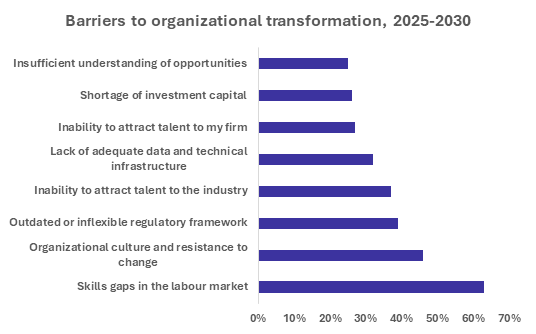
Figure 1: Share of employers surveyed expecting the stated barrier will hinder their organisational transformation. Source: World Economic Forum, Future of Jobs Survey 2024.
For Southeast Asia, this creates a structural opportunity. The region is integrating more deeply into global manufacturing, technology, business services, digital commerce, and international supply chains. Yet competitiveness increasingly depends on workforce quality rather than labour cost alone. Companies can purchase software, machinery, and cloud infrastructure relatively quickly. Building the workforce capable of using those assets effectively is more difficult.
Why the Commercial Model Is Shifting Toward Employers
Consumer-facing education platforms remain important across Southeast Asia. HolonIQ reports that direct-to-consumer companies represented approximately 70% of its 2025 Southeast Asia EdTech cohort, reflecting the region’s large learner base and continued household demand for supplementary education.
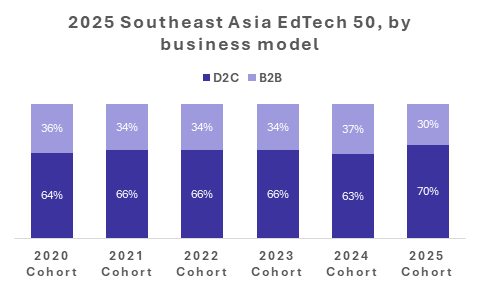
Figure 2: Direct to Consumer platforms strengthen in the 2025 Southeast Asia EdTech 50. Source: 2025 Southeast Asia EdTech 50, HolonIQ by IS
However, consumer scale does not automatically create attractive economics. Many platforms rely on paid advertising, promotions, telesales, and social-media distribution. Customer acquisition costs can rise rapidly when several businesses offer similar content. Learners may also purchase courses with strong initial motivation but fail to complete them, weakening retention and limiting lifetime value. Recorded lessons, basic quizzes, and generic content are also becoming easier to replicate through free videos, low-cost subscriptions, and generative AI. Consumer platforms can still build valuable businesses in examination preparation, language certification, university admissions, and professional qualifications, where willingness to pay is supported by a clear outcome. But the wider market is moving from access to accountability: learners increasingly expect providers to demonstrate what a course enables them to achieve.
Employer-led training addresses a different customer need. Companies purchase learning to improve productivity, support digital transformation, meet compliance requirements, prepare managers, strengthen retention, or fill capability gaps. This creates the potential for recurring contracts, larger learner cohorts, and lower acquisition costs per user. Revenue can be structured through annual licences, per-employee subscriptions, project-based training, certification programmes, managed academies, or outcome-linked contracts. The sales cycle is often longer than in consumer education, but revenue becomes more visible once a provider is embedded in workforce development. A company may begin with cybersecurity training and expand into AI literacy, analytics, leadership, language learning, and digital adoption. Institutional distribution can therefore become an economic moat rather than another sales channel.
Outcomes Are Becoming the Product

The most defensible providers sell more than access to teaching. They sell a result that matters to the learner, employer, or both. For a vocational student, the result may be job placement. For an employee, it may be certification or promotion. For an employer, it may be lower error rates, faster processing, stronger compliance, or quicker adoption of new technology.
More useful performance indicators include contract renewal and seat utilisation for corporate platforms; completion, certification, placement, and salary improvement for vocational academies; proficiency gains for language providers; and employee performance or internal mobility for managed workforce academies.
Measurement is difficult because employment and productivity outcomes are influenced by labour-market conditions, prior experience, management support, and learner motivation. Nevertheless, platforms that can credibly demonstrate outcomes should earn stronger trust, higher renewal rates, and more defensible pricing than providers selling undifferentiated course access.
Where Private Capital Can Build Scalable Platforms
Corporate digital and AI training is one of the most immediate opportunities. Half of employers surveyed by the World Economic Forum expect to reorient their businesses in response to AI, while two-thirds plan to recruit employees with specific AI capabilities. Employees need to use AI responsibly, evaluate outputs, protect confidential information, and redesign workflows.
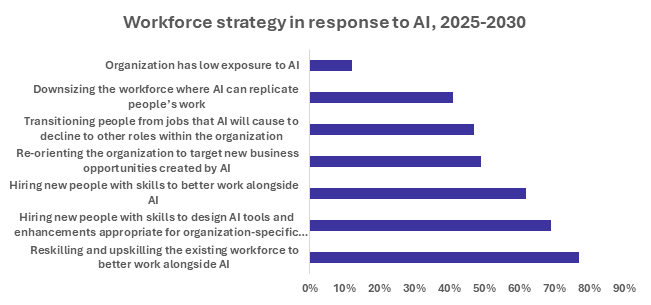
Figure 3: Share of employers surveyed planning to implement the stated strategy in response to AI’s increasing capability and prevalence. Source: World Economic Forum, Future of Jobs Survey 2024.
The attractive model is not simply a library of generic AI courses. Public information is already abundant. Value is more likely to come from role-specific implementation. A bank requires different use cases, controls, and data policies from a manufacturer. Providers that combine instruction with workflow assessment, implementation support, and measurable productivity gains may build stronger customer relationships than content-only platforms. Vocational education and industry certification offer a second opportunity. Programmes in manufacturing technology, logistics, hospitality, healthcare support, cybersecurity, software development, finance, and renewable energy can address specific labour shortages. The strongest providers align curricula with recognised qualifications and employer needs. Company partnerships can improve relevance, create internships, support job placement, and reduce uncertainty.
Employer-linked programmes also create multiple potential payers. Tuition may be funded by learners, companies, government programmes, financial institutions, or combinations of these stakeholders. A provider dependent entirely on low-income students paying upfront may struggle to scale; one connected to employers and financing partners has more options. English and professional communication remain closely linked to economic mobility across Southeast Asia. Employers in tourism, technology, outsourcing, financial services, aviation, manufacturing, and cross-border trade need staff who can communicate with international customers and colleagues. The strongest opportunity is where language learning connects to professional use cases such as customer service, healthcare, technology, finance, or hospitality. AI can reduce the cost of conversation practice and feedback, but enterprise customers will still require quality assurance, reporting, and curriculum relevance.
Managed academies and training-as-a-service provide another scalable model. Some employers know they need new capabilities but lack the internal resources to design curricula, manage instructors, assess employees, and monitor progress. A provider can operate a dedicated academy, combining skills assessment, learning pathways, instructors, technology, certification, and outcome reporting. These models are complex but can create deeper integration and higher switching costs. Southeast Asia workforce training can accommodate several forms of capital. Venture investors may support software, assessments, and AI-enabled delivery. Growth equity can back established platforms expanding across customers or markets. Private equity may consolidate vocational academies, language centres, and corporate-learning providers. Strategic buyers may include education groups, recruitment platforms, universities, consulting firms, HR technology companies, and enterprise-software providers. Private credit may suit established operators with contracted revenue seeking capital for acquisitions, new centres, or technology investment.
AI Changes Delivery Economics, Not the Need for Trust

AI can reduce the cost of delivery by generating practice exercises, personalising learning sequences, simulating workplace conversations, translating content, providing feedback, supporting assessment, and helping instructors identify struggling learners. It can also make localisation across Southeast Asian markets faster and less expensive.
However, almost every platform can add an AI assistant, automated quiz generator, or conversational interface. These features may improve the user experience, but they do not automatically improve outcomes or create defensibility. Competitive advantage comes from combining technology with proprietary content, credible assessment, recognised qualifications, employer data, and institutional distribution.
Trust is particularly important in professional education. Employers need confidence that employees have acquired genuine capabilities rather than merely completed automated modules. Investors should ask whether AI improves completion or proficiency, reduces instructor time without lowering quality, protects employer and learner data, and improves margins rather than merely increasing development costs. The winners will not necessarily be the platforms using the most AI, but those using it to produce better outcomes at more attractive delivery economics.
A Fragmented Market Creates a Consolidation Opportunity
HolonIQ’s 2025 Southeast Asia EdTech cohort indicates a maturing ecosystem. More than half of the selected companies were between four and six years old, while only 4% were early-stage businesses established within the previous three years. Workforce and skills solutions represented approximately one-third of the cohort. Singapore accounted for nearly half of selected company headquarters, while Vietnam and Indonesia together represented around 40%.
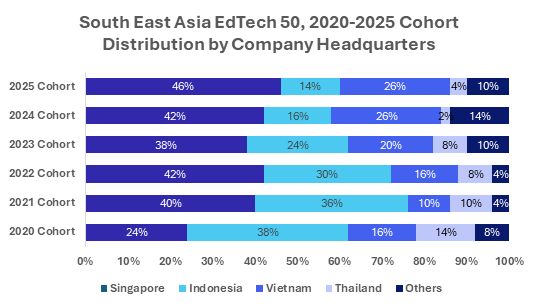
Figure 4: Singapore solidifies as regional hub with nearly 50% of the cohort share, with Vietnam representing a quarter and Indonesia expanding. Source:
2025 Southeast Asia EdTech 50, HolonIQ by IS
These figures describe HolonIQ’s selected cohort rather than the entire market, but they highlight a regional ecosystem with increasingly established operators and significant geographic fragmentation. Many training providers remain founder-led and locally focused. They may possess strong instructors, employer relationships, or recognised programmes but lack technology, governance, sales infrastructure, and regional reach.
A platform investor can acquire a credible anchor business and add complementary capabilities. A corporate-learning provider may acquire a language-training company. A vocational academy may add recruitment and placement services. A software platform may acquire instructor-led delivery capacity. Value creation includes cross-selling, shared distribution, stronger certifications, centralised content, improved data systems, and disciplined sales management.
Workforce training is not a conventional software roll-up. Instructor quality, local reputation, accreditation, and employer relationships often sit within individual teams. Aggressive integration can destroy value if it removes the people and processes that created trust. The strongest strategies will preserve credibility while professionalising systems and expanding only after the operating model is repeatable.
Risks and Structural Headwinds

The first risk is weak outcomes. Learners may enrol but fail to complete programmes, while reported placements may reveal little about job quality, retention, or salary improvement. Investors should examine results by programme and cohort rather than relying on company-wide averages. A second risk is dependence on corporate budgets. B2B revenue can be recurring, but training expenditure may be reduced when companies face cost pressure. Providers need diversified customers, limited contract concentration, and programmes tied to essential capabilities rather than discretionary employee benefits.
Instructor and content quality also remain critical. Professional learners disengage from theoretical, outdated, or poorly delivered material. Rapid expansion may dilute teaching quality or increase reliance on junior instructors. Durable providers must retain subject-matter experts while converting their knowledge into standardised systems. Regulation and credentials vary across Southeast Asia. Education licensing, professional recognition, data privacy, consumer protection, and financing rules differ by country. A certification valued in Singapore may have limited recognition in Vietnam or Indonesia. Regional growth therefore requires localisation and regulatory capability, not only translation.
Finally, returns on training are difficult to attribute. Employee improvement may result from training, management support, new technology, or experience. Strong providers establish baseline assessments, agree performance indicators with employers, and evaluate outcomes over time.
Closing Perspective: From Courses to Human-Capital Infrastructure

Southeast Asia workforce training is not primarily a digital-content story. It is a response to a deeper economic requirement: companies need workers whose capabilities can evolve as quickly as their technology and business models.
The strongest platforms will compete on employer access, curriculum relevance, credible assessment, learner completion, job placement, productivity, and recurring institutional relationships. The most compelling opportunities sit where learning connects to a measurable economic outcome: corporate AI adoption, vocational certification, professional communication, managed academies, and employment-linked training.
Execution remains the dividing line. Training businesses require more than attractive software and aggressive customer acquisition. They need employer trust, instructional depth, recognised credentials, disciplined unit economics, and evidence that workers become more capable after using the product. For investors able to combine technology with patient operational development, Southeast Asia workforce training may become one of the region’s most durable education-related themes.
For deeper insights on education platforms, human-capital investment, digital transformation, and emerging market opportunities, follow DealFlow for research-driven perspectives on global finance via LinkedIn or explore further analysis at DealFlow.sg.