On Monday 21 September 2026, Vietnam formally entered the FTSE Russell secondary emerging market universe. The reclassification took effect almost seven years after FTSE Russell first placed Vietnam on its watchlist in September 2018, and a little over five months after the confirmation at the interim review on 8 April 2026. For a market that has long ranked among the most liquid in ASEAN yet sat outside the main institutional benchmarks, the Vietnam FTSE upgrade marks a structural threshold. It converts a retail-driven, frontier-classified exchange into an index destination that global allocators can hold by mandate rather than by exception. The headline passive inflow is modest. The more important shift is who now owns Vietnam.
Why the Vietnam FTSE Upgrade Matters Beyond the Headline Inflow

The immediate passive flow tied to the reclassification is small relative to the market’s size. The first tranche in September 2026 carried roughly USD 220 million of index-driven demand, and full passive inclusion by September 2027 is estimated at around USD 1.5 billion to USD 2.4 billion. That sits against a market capitalisation of more than USD 300 billion, so on its own the flow would move the VN-Index by a few sessions of turnover and little else.
The reclassification matters for a different reason. Frontier status is a gate, not a label. Most large institutional mandates, pension pools, and global emerging market funds are benchmarked to indices that exclude frontier markets entirely. A frontier tag therefore caps the addressable investor base regardless of how liquid or cheap a market is. Secondary emerging market status removes that gate. It makes Vietnam eligible for a passive pool of roughly USD 1.4 trillion tracking the relevant FTSE indices, and a far larger active pool, and it changes the composition of demand from fast-money frontier specialists toward benchmarked, longer-duration institutional holders.
That is the real thesis behind the reclassification. The value is not the one-time rebalancing trade. It is the migration from frontier liquidity, which Vietnam already has in abundance, toward institutional capital formation, which it has lacked. The distinction shapes every second-order effect that follows, from primary market depth to the cost of equity for listed issuers.
How Seven Years of Reform Cleared the Reclassification Bar
The Vietnam FTSE upgrade was earned through a sequence of specific, verifiable reforms rather than a single event. FTSE Russell’s binding concerns had been the pre-funding requirement for foreign institutional buyers, the absence of a formal process for handling failed trades, and market access through global brokers. Each was addressed through regulation and market infrastructure over 2024, 2025, and early 2026.
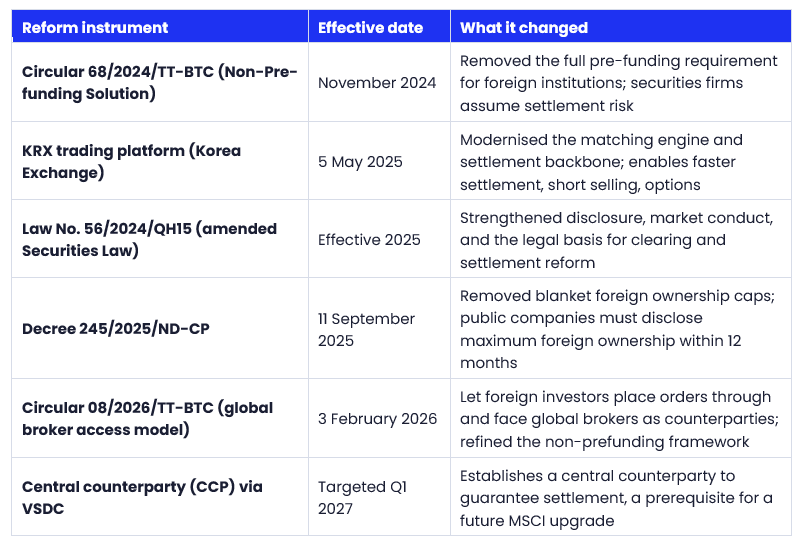
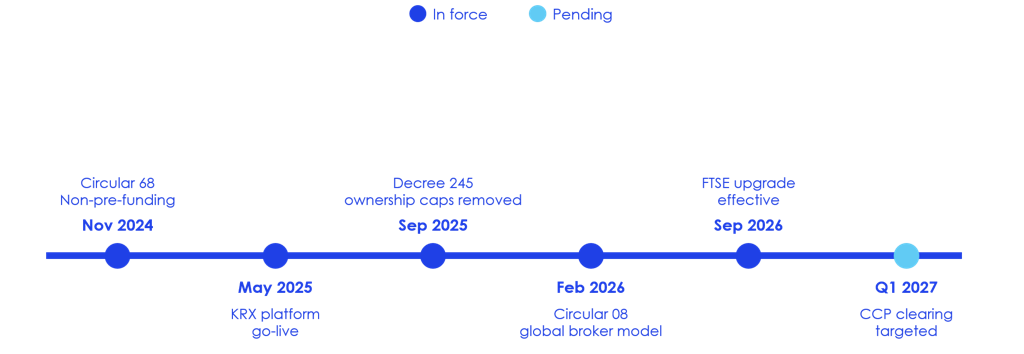
Figure 1 Reform chronology behind the Vietnam FTSE upgrade (Source: Ministry of Finance of Vietnam, State Securities Commission, FTSE Russell).
The last piece was the one that closed the decision. At its interim review on 8 April 2026, FTSE Russell’s Index Governance Board assessed Vietnam’s progress on the global broker access model, which lets foreign institutions trade through and face global brokers as counterparties and is essential for reliable index replication. Circular 08/2026, issued on 3 February 2026, established the legal framework for that model and tightened the non-prefunding regime. The board confirmed it was satisfied, and Vietnam stayed on track for implementation from the open on 21 September 2026. The reform effort transmits into capital formation through a clear chain.
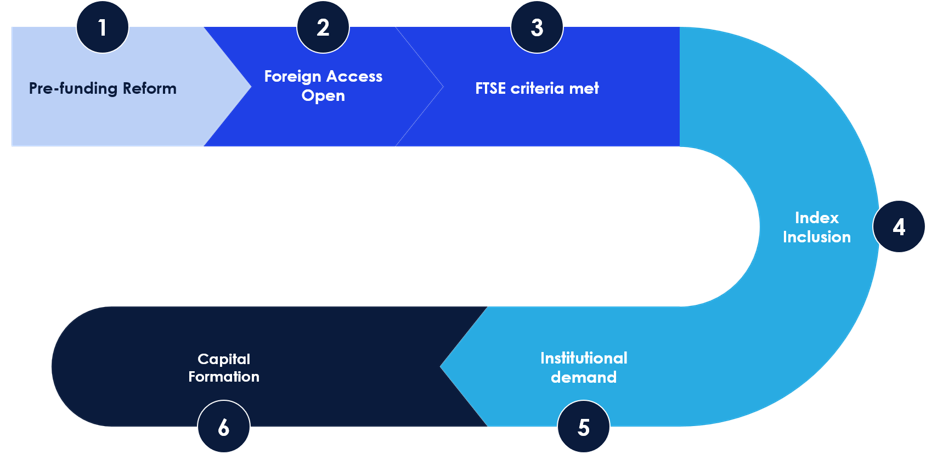
Figure 2 Reform-to-capital-formation transmission chain (Source: DealFlow analysis based on the FTSE Equity Country Classification Framework).
Sizing the Capital Formation Opportunity
Index inclusion under the Vietnam FTSE upgrade is phased, not immediate. FTSE Russell brings Vietnam into the secondary emerging market index across four tranches over roughly one year, which spreads the rebalancing demand and reduces single-day price impact.
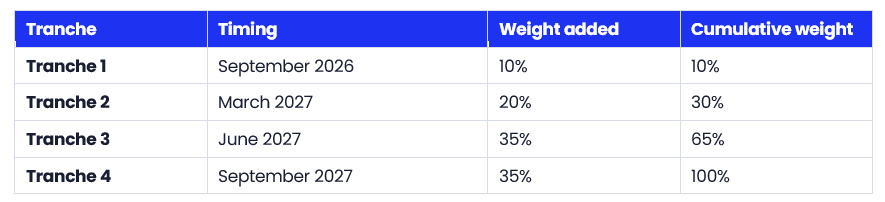
Table 1: Phased inclusion schedule for the Vietnam FTSE upgrade (Source: FTSE Russell Vietnam Reclassification FAQ and Implementation Plan, 21 August 2026).
On weighting, Vietnam enters as a small constituent. FTSE Russell’s implementation plan puts its share at roughly 0.49% of the FTSE Emerging All Cap index and about 0.31% of the FTSE Emerging index at full inclusion, with far smaller weights in the global aggregates. Those weights anchor the passive flow math.
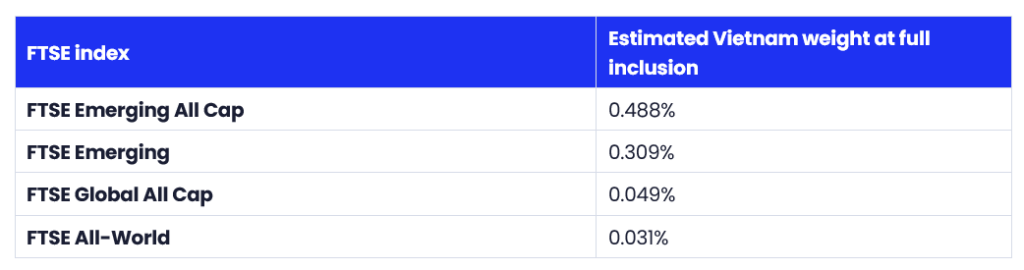
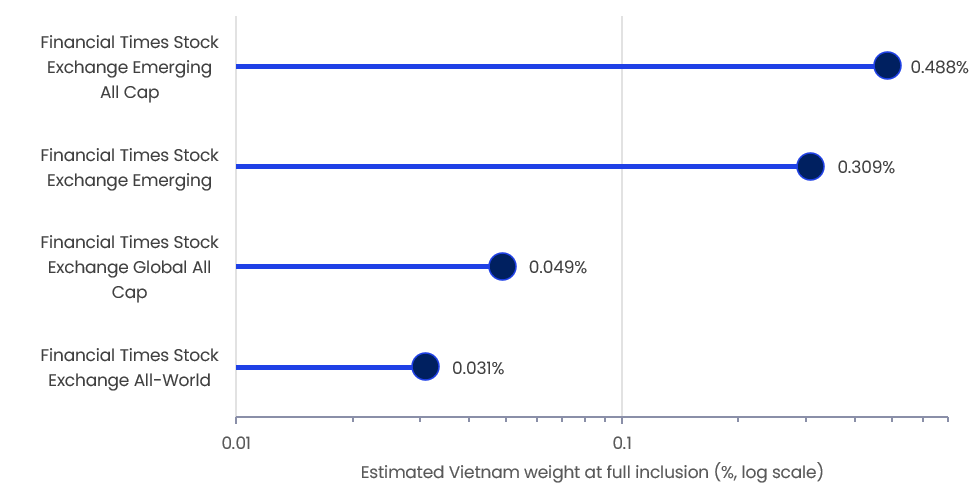
Figure 3 Estimated Vietnam weight across FTSE indices at full inclusion (Source: FTSE Russell Vietnam Reclassification FAQ, projections as of 21 August 2026).
The inflow estimates rise sharply once active money is included, and the dispersion is instructive. Passive demand is small and well bounded. The larger, wider numbers depend on discretionary active allocation, which is a decision rather than a mechanical rebalance.
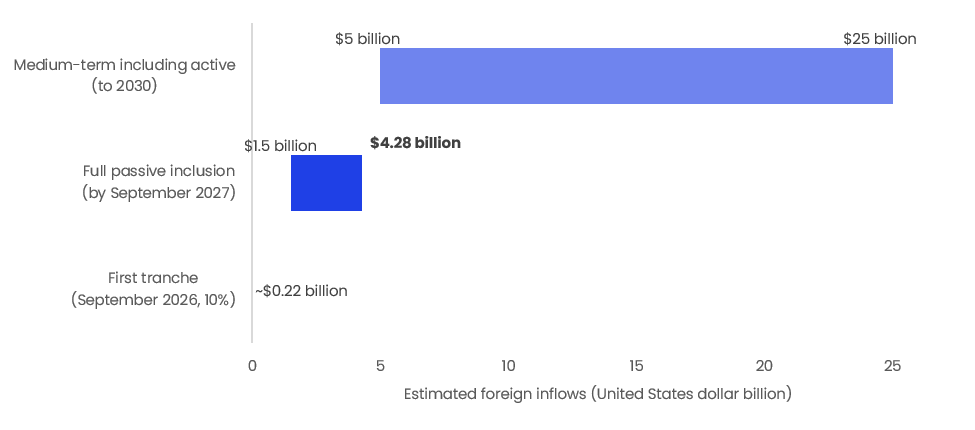
Figure 4 Estimated foreign inflows tied to the Vietnam FTSE upgrade, by phase (Source: VNDirect, VPS Securities, SSI Research, World Bank).
At the security level, inclusion demand concentrates in the largest, most liquid names. FTSE Russell added 27 Vietnamese securities to its All-Cap index across large, mid, and small-cap bands, plus a wider group of micro-cap names. Six of the 27 also qualify for the FTSE All-World index, and those six absorb the priority passive demand.
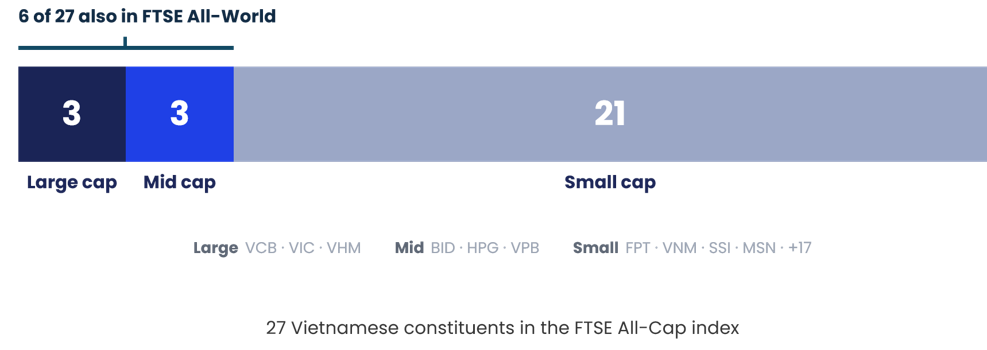
Figure 5 Vietnamese constituents in the FTSE All-Cap index at inclusion (Source: FTSE Russell September 2026 semi-annual review).
From Retail Liquidity to Institutional Depth

Vietnam already trades like a much larger market. Average daily turnover runs near USD 1 billion in normal conditions and has spiked above USD 2.9 billion in stronger periods, which makes Vietnam the most liquid exchange in ASEAN by matched value. Liquidity has never been the problem.
The problem is the composition of that liquidity. Domestic retail investors drive the overwhelming majority of daily turnover, on the order of 80% or more of matched value That profile produces high turnover and high volatility, but shallow price discovery and thin institutional ownership. Retail-dominated liquidity is easy to enter and easy to exit, which is precisely why it does little to lower an issuer’s cost of capital or support large primary raises.
Institutional capital behaves differently. Benchmarked funds hold positions for longer, size them against index weight rather than momentum, and reward disclosure and governance with a lower discount rate. This is the substance of the Vietnam FTSE upgrade thesis. The reclassification begins a rotation in the investor base from frontier liquidity toward institutional depth. Over time that rotation should tighten valuation dispersion, deepen the primary market for equity issuance, and give the largest issuers a credible path to raising strategic capital on domestic screens rather than offshore.
The re-rating that accompanied the reform run supports the direction of travel. The VN-Index rose from roughly 1,100 points in April 2025 to around 1,800 by September 2026 as the market priced in the reclassification, and foreign investors turned net buyers in the run-up after months of net selling. The task now is to convert that anticipatory re-rating into a durable ownership change rather than a completed trade.
The Binding Constraints That Still Cap Investability

Index eligibility is necessary but not sufficient. The gap between being in the index and being genuinely investable at scale is where the reclassification will be tested over the next 12 to 24 months. Several constraints remain live.
Foreign ownership limits are the first. Decree 245/2025 removed blanket caps and mandated disclosure, but sector-specific limits and company-level room still bind in banking and other regulated industries. When a stock hits its foreign ownership ceiling, incremental institutional demand cannot be filled at the listed price, which suppresses the effective free float available to global funds.
English-language disclosure is the second. Only an estimated 25% to 30% of listed companies currently provide complete English disclosures. VN30 constituents face a 1 January 2025 requirement and all listed companies must transition by the end of 2026, but the current gap limits how much of the market foreign institutions can underwrite with confidence.
Settlement infrastructure is the third. The central counterparty mechanism through VSDC is targeted for full operation around Q1 2027. Until a CCP guarantees settlement, Vietnam falls short of the higher bar required for an MSCI emerging market upgrade, which remains the larger prize given the deeper pools benchmarked to MSCI.
Currency and repatriation friction is the fourth. Foreign investors weigh dong stability and the ease of moving capital out as much as they weigh index membership. Operational reliability across a full market cycle, not a single rally, is what converts eligibility into sustained allocation.
Investment Angles for Institutional Allocators

- The constituent basket. The six names that sit in both the FTSE All-Cap and FTSE All-World indices, led by VCB, VIC, and VHM, capture the cleanest passive demand across the four tranches through September 2027. Foreign ownership room, not size alone, determines which of them can actually absorb the flow.
- The MSCI optionality. The FTSE reclassification proves Vietnam can clear an international classification bar. The CCP launch in 2027 is the next catalyst, and an MSCI review pathway toward 2027 or 2028 would unlock a materially larger capital pool. Positioning ahead of that second gate carries more asymmetry than the FTSE flow itself.
- The primary market. As the investor base institutionalises, the window for large equity raises, block placements, and strategic minority stakes on domestic screens widens. For corporates and their advisers, the upgrade improves the terms and feasibility of raising institutional capital in-market. This is where reclassification connects directly to deal formation rather than to secondary trading.
- Selective, valuation-aware entry. Much of the reclassification has been priced through the 2025 re-rating. Allocators are better served by focusing on issuers where governance, disclosure, and free float are improving fastest, since those are the names that attract sticky institutional ownership rather than a one-time rebalancing bid.
The Next Phase of Vietnam’s Capital Market
The Vietnam FTSE upgrade is best read not as an inflow event but as a change in the character of the market. The passive money that arrives between September 2026 and September 2027 is real but modest. The durable value lies in the transition it begins, from a deeply liquid but retail-driven frontier exchange toward a market capable of institutional capital formation. That transition rests on reforms that are already in force, including the global broker access model that closed the decision, and on a further set of constraints, foreign ownership headroom, English disclosure, and central counterparty settlement, that will decide whether eligibility becomes genuine investability and, in time, an MSCI upgrade.
For investors and corporates active in Vietnam, the reclassification reframes the opportunity from timing a rebalancing trade to positioning for a structurally different investor base. DealFlow works with institutional allocators and issuers to translate the Vietnam FTSE upgrade into concrete positioning, from constituent-level analysis to primary capital strategy. Contact the DealFlow team to discuss how the reclassification reshapes your Vietnam and Southeast Asia allocation.