Thailand’s PromptPay and Singapore’s PayNow became the first linked real-time payment systems in the world in April 2021. Five years later, the links are spreading quickly, but usage is still thin. In Vietnam, inbound QR payments by visitors from Thailand, Laos and Cambodia rose eightfold by volume in the first eight months of 2026, according to the State Bank of Vietnam and NAPAS. Yet only about 154,000 of more than 2.5 million payment acceptance points, around 6%, accept cross-border VietQR Global payments, according to the State Bank of Vietnam’s Payment Department. That gap defines the opportunity in ASEAN cross-border payments. The question for investors is who earns money as traffic catches up.

ASEAN Cross-Border Payments Are Moving From National Networks to Regional Connectivity
Southeast Asia built strong domestic instant-payment systems before it connected them. Thailand has PromptPay, Singapore has PayNow, Malaysia has DuitNow, Indonesia has QRIS and BI-FAST, Vietnam has NAPAS and VietQR, and the Philippines has InstaPay and QR Ph. Each was designed for one market and one currency. A payment that crossed a border still had to travel through card schemes or correspondent banks, with foreign-exchange conversion and fees added at each step.
That friction is still measurable. In an October 2026 keynote, AMRO’s Director noted that only about 35% of retail cross-border payment services delivered funds within one hour in 2025, against a G20 target of 75%. Person-to-person payments cost about 2.6% against a 1% target. The World Bank put the global average cost of a remittance at 6.36% in the third quarter of 2025.
Global cross-border payments still miss G20 speed and cost targets
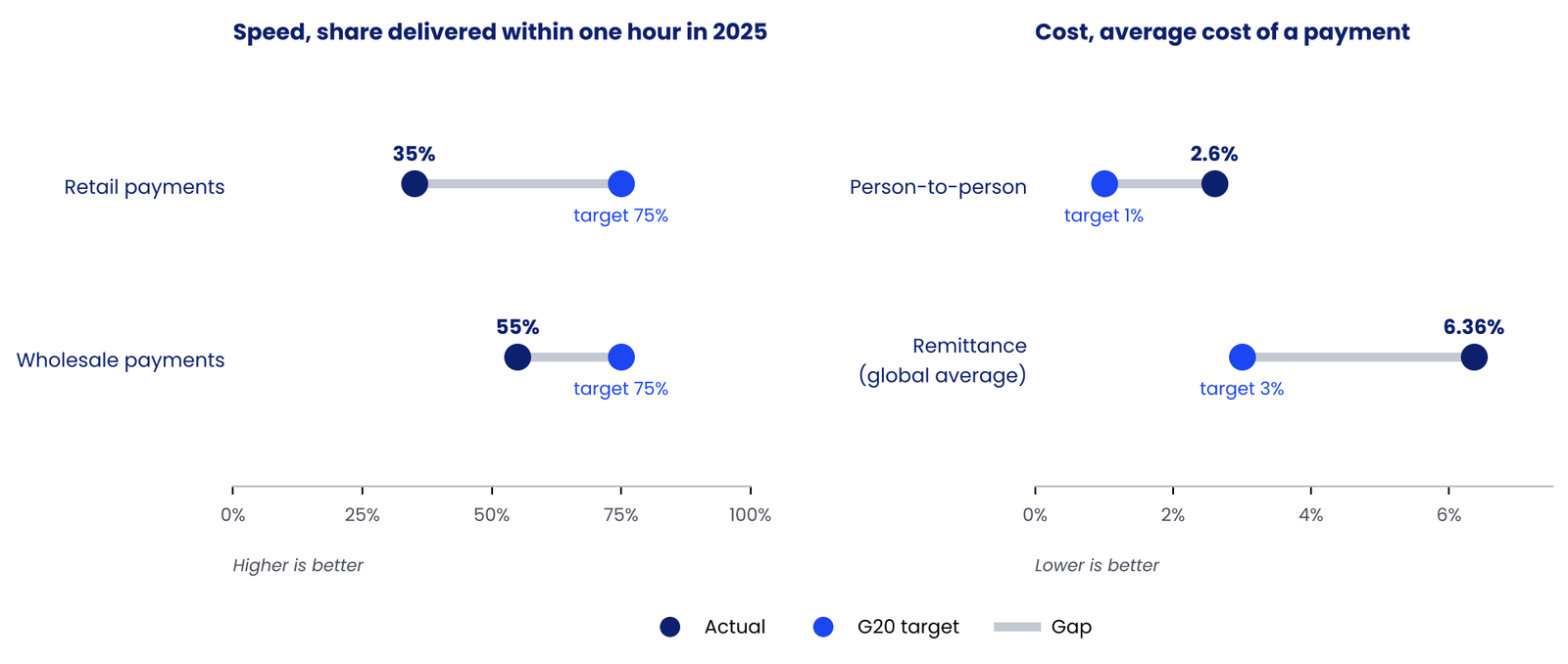
Figure 1: Global speed and cost of cross-border payments against G20 targets; remittance target is for 2030 (Source: AMRO, October 2026; World Bank Remittance Prices Worldwide, Q3 2025; FSB targets, 2021).
Central banks have responded with formal cooperation. The Regional Payment Connectivity (RPC) agreement, initiated in November 2022 by five central banks, was joined by Vietnam in August 2023 and Brunei and Lao PDR in 2024. Cambodia’s accession in April 2025 brought membership to nine ASEAN central banks. By April 2025, Bank Negara Malaysia’s Governor counted 21 payment linkages operating in the region. ASEAN leaders also backed a task force on a Local Currency Transaction framework in May 2023.
Tourism and regional trade are the commercial drivers. Vietnam received 17.7 million international visitors in the first nine months of 2026, up 14.5% year on year. The Asian Development Bank reported in July 2026 that Asia and the Pacific account for about two-thirds of global e-commerce sales, while many smaller firms still cannot fully take part in cross-border trade.
Most of this ASEAN payment connectivity is bilateral. Each link needs its own technical build, rulebook and regulatory agreement, and AMRO notes that cost and complexity rise as the network grows. Moving from a web of pairs to a regional system requires shared infrastructure and settlement arrangements, not only policy cooperation.
ASEAN cross-border payment connectivity, October 2026
| Country | Live cross-border QR or payment links | Project Nexus |
| Singapore | Thailand, Malaysia, India, Indonesia, Vietnam | Founding member |
| Thailand | Singapore; QR from 9 countries accepted | Founding member |
| Malaysia | Singapore, Thailand, Indonesia, China, Cambodia | Founding member |
| Indonesia | Thailand, Malaysia, Singapore, Japan, South Korea, China | Joined Feb 2026 |
| Vietnam | Thailand, Laos, Cambodia, China, South Korea, Singapore | Not a member |
| Philippines | Malaysia link announced, not confirmed live | Founding member |
Figure 2: Live cross-border links by country and Nexus status; Nexus go-live reported as targeted for 2027 (Source: MAS, BOT, BI, SBV, PayNet, Nexus Global Payments).
The Infrastructure Behind Regional Payment Interoperability Is Still Being Built
A cross-border QR payment looks simple to the user. A traveller scans a merchant’s code with a home banking app. The home provider sends the instruction through its national switch to the partner country’s switch. The amount is converted, and the merchant receives local currency. On the PromptPay to PayNow link, fees are shown to the sender before confirmation. Settlement between the participating banks happens separately, behind the retail message.
How an ASEAN cross-border payment travels through the financial system
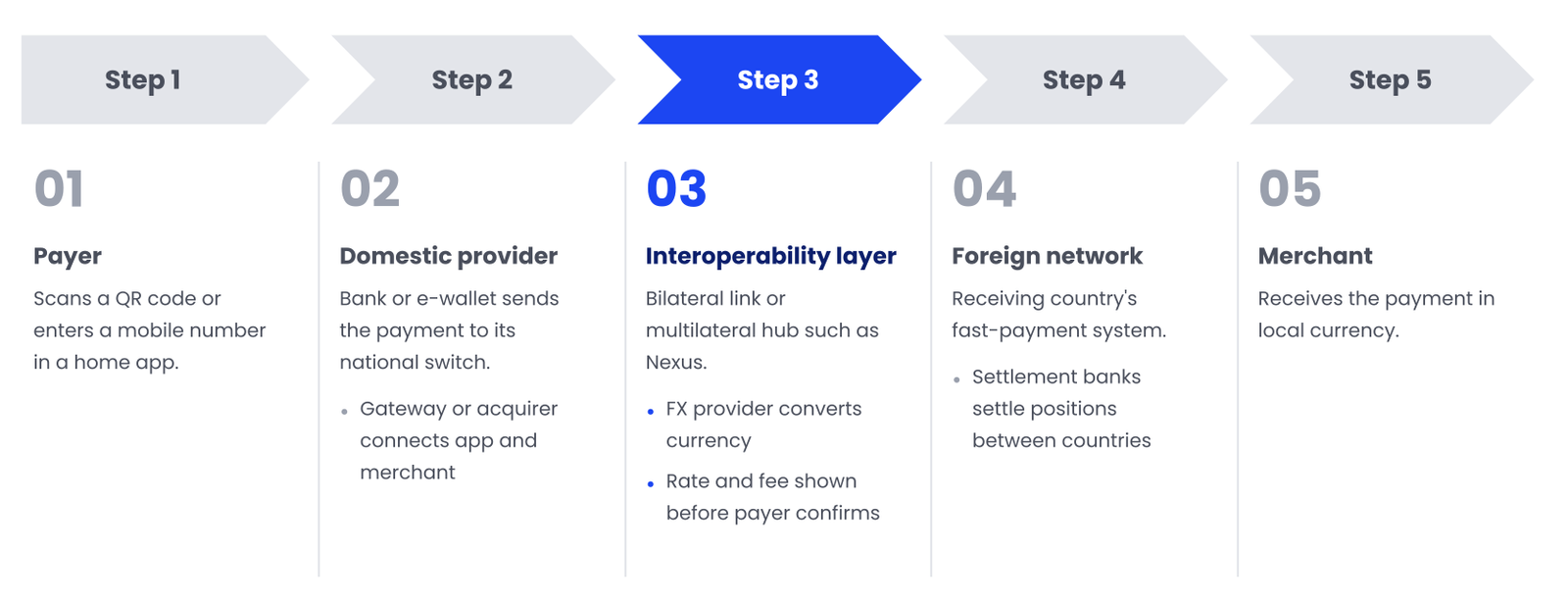
Figure 3: Simplified retail cross-border payment flow, with the interoperability layer highlighted. Illustrative only (Source: DealFlow analysis based on BOT and MAS, AMRO and ADBI).
Bilateral QR Links Have Delivered the First Visible Results
According to research published by the Asian Development Bank Institute in October 2026, cross-border QR linkages have so far produced the most visible results in ASEAN. Singapore is a useful case. After PromptPay in 2021, it connected with Malaysia’s DuitNow QR in March 2023 and launched an account-to-account PayNow and DuitNow link in November 2023. Its link with India’s UPI in February 2023 was the first to include a non-bank participant. Vietnam’s QR link with Singapore went live in July 2026, taking NAPAS to six connected countries.
Project Nexus Aims to Replace Many Links With One Connection
Project Nexus is designed to let a national system connect once to a common platform and reach every other member. It began as a Bank for International Settlements Innovation Hub project, which tested a prototype in 2023 and delivered a scheme, governance and technology blueprint in July 2024. In April 2025 the central banks of India, Malaysia, the Philippines, Singapore and Thailand incorporated Nexus Global Payments in Singapore to run it. Bank Indonesia joined as the sixth member in February 2026. A joint venture of PayNet and NETS was appointed technical operator the same month, with go-live reported as targeted for 2027. The ADBI brief is explicit that Nexus should not yet be described as a fully operational regional network. Vietnam is not a member.
Project Nexus milestones from blueprint to target go-live
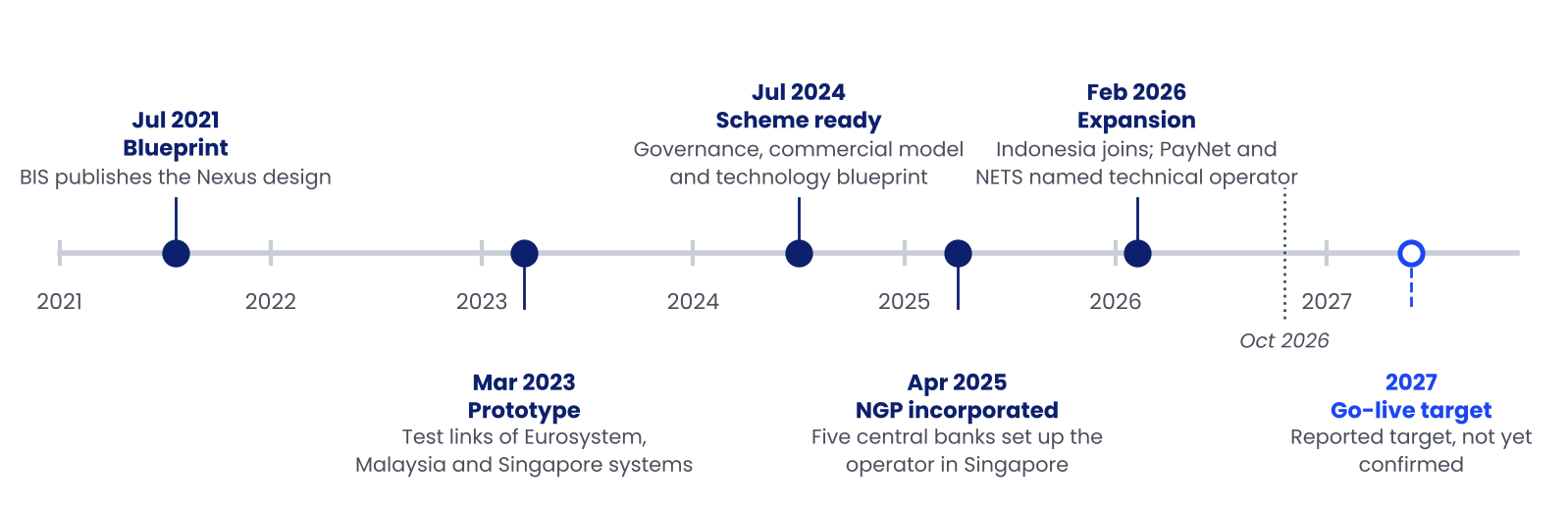
Figure 4: Project Nexus milestones; the 2027 go-live is a reported target (Source: BIS, Bank of Thailand, Bank Indonesia, Nexus Global Payments).
Retail Speed Has Outpaced Wholesale Settlement
The harder problem sits underneath. AMRO notes that wholesale connectivity requires coordinated settlement, access to liquidity and safe foreign-exchange settlement, and that only about 55% of wholesale cross-border payments reached recipients within an hour in 2025. The ADBI brief adds that correspondent banking has become more concentrated, and that new arrangements are likely to complement correspondent banks rather than replace them. Cross-border payment settlement therefore remains a specialist, capital-intensive function.
Connectivity has strategic value only if people use it. The next question is whether transaction data supports the infrastructure story.
What the 2026 Data Reveals About Commercial Adoption
Usage of ASEAN cross-border payments over QR is growing quickly, but from a low base, and countries report it in different ways. The figures should be read country by country rather than added up.
Indonesia offers the most complete picture. Bank Indonesia reported that cross-border QRIS payments reached Rp7.63 trillion and 25.67 million transactions from launch in August 2022 to July 2026. Foreign visitors paying in Indonesia accounted for 21 million transactions worth Rp5.90 trillion, while Indonesians paying abroad made 4.67 million transactions worth Rp1.73 trillion. In the second quarter of 2026 alone, net inbound value was Rp1.52 trillion.
Thailand shows the fastest growth. Inbound cross-border QR payments reached THB1.51 billion in May 2026, up 382% year on year, according to operator National ITMX, with Chinese visitors the largest source. Scale is still modest. A Bank of Thailand and Visa study found that inbound QR payments in 2024 equalled only about 0.2% of tourist spending.
Malaysia and Vietnam confirm the trend. PayNet processed 29.7 million cross-border QR transactions in 2025, 2.5 times the prior year. Vietnam’s inbound volume rose eightfold and outbound volume fivefold in the first eight months of 2026, though no absolute figures were published.
Cross-border QR usage is growing fast while acceptance lags
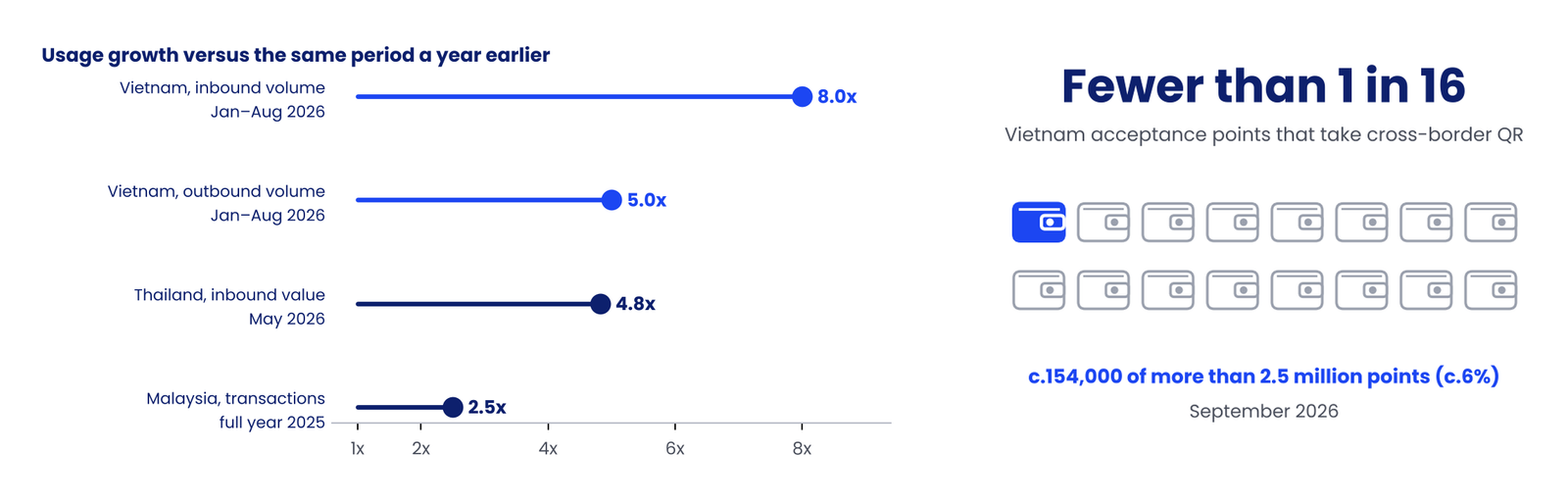
Figure 5: Reported growth in cross-border QR usage, and Vietnam’s acceptance coverage. Periods and definitions differ by country (Source: SBV and NAPAS, National ITMX, PayNet, SBV Payment Department).
Two gaps stand out. Singapore and the Philippines have not published recent usage figures. And the flow is mostly inbound tourism spending, which ties volumes to travel cycles and a few source markets. Volume growth alone also does not make a business attractive. A platform can process far more payments while earning less on each one.
Who Captures the Value in ASEAN Cross-Border Payments
The economics of ASEAN cross-border payments differ sharply from card-based travel spending. When a tourist pays by card, the issuer, the card scheme and the acquirer share interchange, scheme fees and a foreign-exchange markup. QR links route the same payment through domestic rails that were built to be cheap. In Indonesia, QRIS merchant discount rates are set at 0.3% for micro merchants and 0.7% for regular merchants, and small micro-merchant payments have been free of charge since December 2024. Cross-border pricing is not published on the same basis, but the direction is clear.

The national switches, including PayNet, NETS, NITMX and NAPAS, run the links. They are central-bank-linked or bank-owned utilities and are rarely available to private buyers. Value therefore tends to collect at three points around them, in DealFlow’s assessment.
- Foreign-exchange conversion. Someone must price and settle the currency leg. Upfront fee disclosure on links such as PayNow and PromptPay makes spreads visible and pushes them down. Providers with licences, liquidity and treasury skill can still earn on volume.
- Merchant acceptance. Only a small share of Vietnam’s merchants can accept foreign QR payments today. Acquirers and gateways that sign up those merchants control the point of sale.
- Multi-country platforms. Firms licensed in several markets can sell one connection to businesses that need many. Airwallex reported annualised revenue of US$1.3 billion, up 74%, when it raised US$320 million at an US$11 billion valuation in June 2026. Thunes cited positive EBITDA at its 2025 Series D.
The tension is straightforward. Volume is rising, revenue per transaction is falling, and fixed costs for compliance, fraud controls and technology are rising. Operating leverage only appears once a provider has enough volume across enough corridors. Banks keep the customer relationship and network access, but QR links weaken their card-based foreign-exchange income. Single-country processors face the hardest squeeze.
Fragmentation Beyond Technology Limits Regional Scale
The technical links behind ASEAN cross-border payments are improving faster than the rules around them. AMRO lists different operating hours, capital flow measures, anti-money-laundering requirements and settlement finality as continuing obstacles. Participants at AMRO’s September 2026 research seminar warned that geopolitical splits could produce competing payment systems.
Licensing is the clearest barrier to regional scale. Singapore requires a Major Payment Institution licence once a provider exceeds S$3 million a month for one service. Vietnam’s Decree 52/2024 sets minimum capital of VND50 billion for e-wallets and payment gateways and requires a legal representative resident in Vietnam. Indonesia’s Bank Indonesia Regulation 22/23/PBI/2020 allows foreign investors up to 85% of a non-bank payment provider but reserves 51% of voting rights for Indonesian shareholders. Thailand licenses payment services under its Payment Systems Act. A regional business must hold and maintain each permission separately.
Fraud adds cost. Singapore recorded S$913.1 million in scam losses in 2025, and Vietnam has required biometric checks on transfers above VND10 million since July 2024. Faster payments make losses harder to recover. For valuation, the point cuts both ways. Licences are hard to replicate, but compliance failures can close a corridor overnight. Buyers should test whether a target’s growth depends on a regulatory concession that could change.
Where the Investment Opportunities Lie in ASEAN Payment Infrastructure M&A
Transaction activity since 2024 shows where buyers see value in the region. NTT DATA agreed in 2024 to buy 58.7% of Malaysia’s GHL Systems for RM724 million, gaining more than 480,000 payment terminals across Malaysia, the Philippines and Thailand. Xendit bought Payex, a payment gateway licensed by Bank Negara Malaysia, in October 2025 and kept its local licence, then took full ownership of the Philippines’ Dragonpay in July 2026. A September 2026 filing showed Ant International holding Indonesia’s DOKU indirectly through a local holding company. In Vietnam, MoMo was reported by Reuters in July 2026 to be weighing new investors, though the process may not lead to a transaction.
Selected Southeast Asian payment transactions, 2024 to 2026
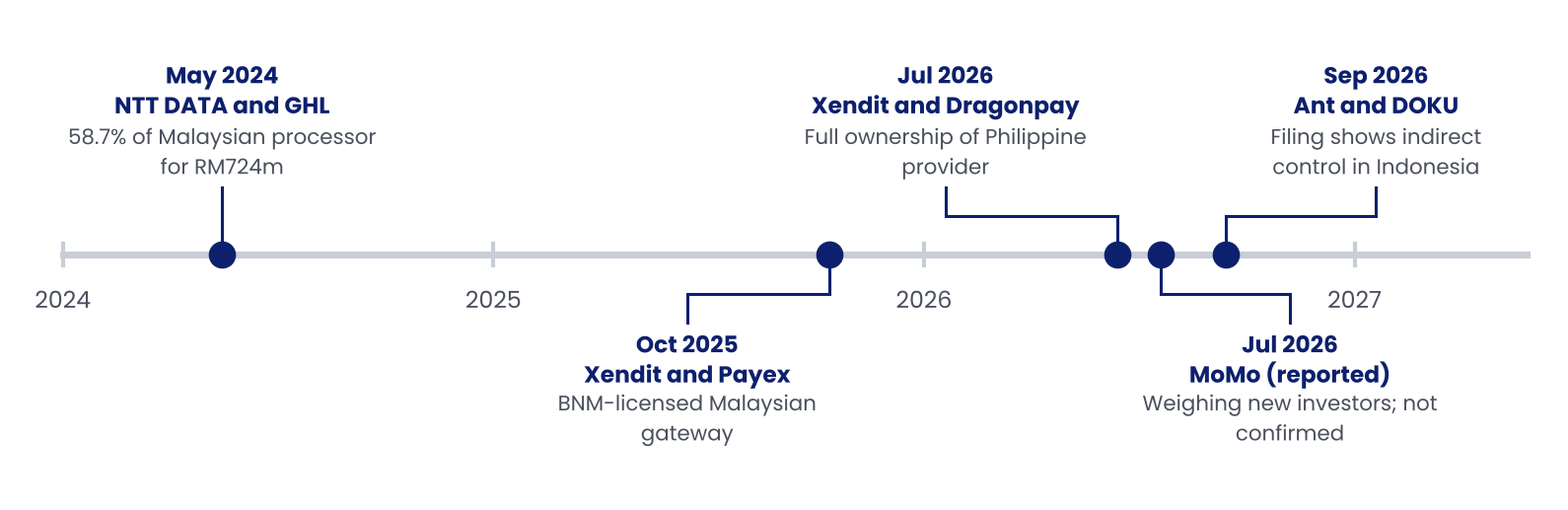
Figure 6: Selected acquisitions and reported processes; MoMo is a reported process only (Source: company disclosures and filings as reported by Fintech News, Dealroom, DealStreetAsia and Reuters).
The pattern across these deals is consistent. Buyers are acquiring licensed local businesses rather than building from scratch. Payex kept its Malaysian licence after the deal. DOKU sits inside a local holding company, as Indonesian rules require. GHL brought an installed base of terminals and merchants. In each case the buyer gained regulated access, merchant relationships and a working connection to the national switch in one step. That fits the barriers described above, which make a regional footprint slow and expensive to build organically.
The forward signal concerns where value is likely to settle as the rails mature. Bilateral QR links keep adding corridors, and Nexus is reported to target go-live in 2027. As the rails become cheaper and more interchangeable, the scarce assets in ASEAN cross-border payments are likely to be those around them. These are local licences, merchant acceptance networks, and foreign-exchange and settlement capability. With only about 6% of Vietnam’s acceptance points enabled for cross-border QR, these assets have room to grow. If the pattern since 2024 continues, the consolidation of licensed single-market players into regional platforms is a plausible next stage. This is a reading of observed activity, not a forecast of specific transactions. For investors weighing entry into the region, and for payment businesses considering a capital raise or a strategic partner, timing and positioning will matter. DealFlow advises on buy-side and sell-side M&A and fundraising across Southeast Asia. Connect with our team to discuss how these shifts affect your plans.