Over the past decade, green finance has evolved from a niche segment of sustainable investing into one of the fastest-growing pillars of global capital markets. What was once a small corner of environmental finance is now mobilising trillions of dollars toward renewable energy, infrastructure, and industrial transition.
This shift reflects a deeper structural change. Climate change is no longer viewed solely as an environmental challenge—it has become a capital allocation challenge for the global economy. Financing the energy transition requires massive long-term investment across power generation, transportation systems, and industrial supply chains, with financial markets increasingly serving as the primary mechanism through which this transition is funded.
As instruments such as green bonds, sustainability-linked loans, and climate investment funds expand rapidly, green finance is becoming embedded within the architecture of global financial markets. Understanding this shift is therefore essential for investors, policymakers, and corporate leaders navigating the next phase of global economic transformation.
The Rapid Expansion of the Green Bond Market
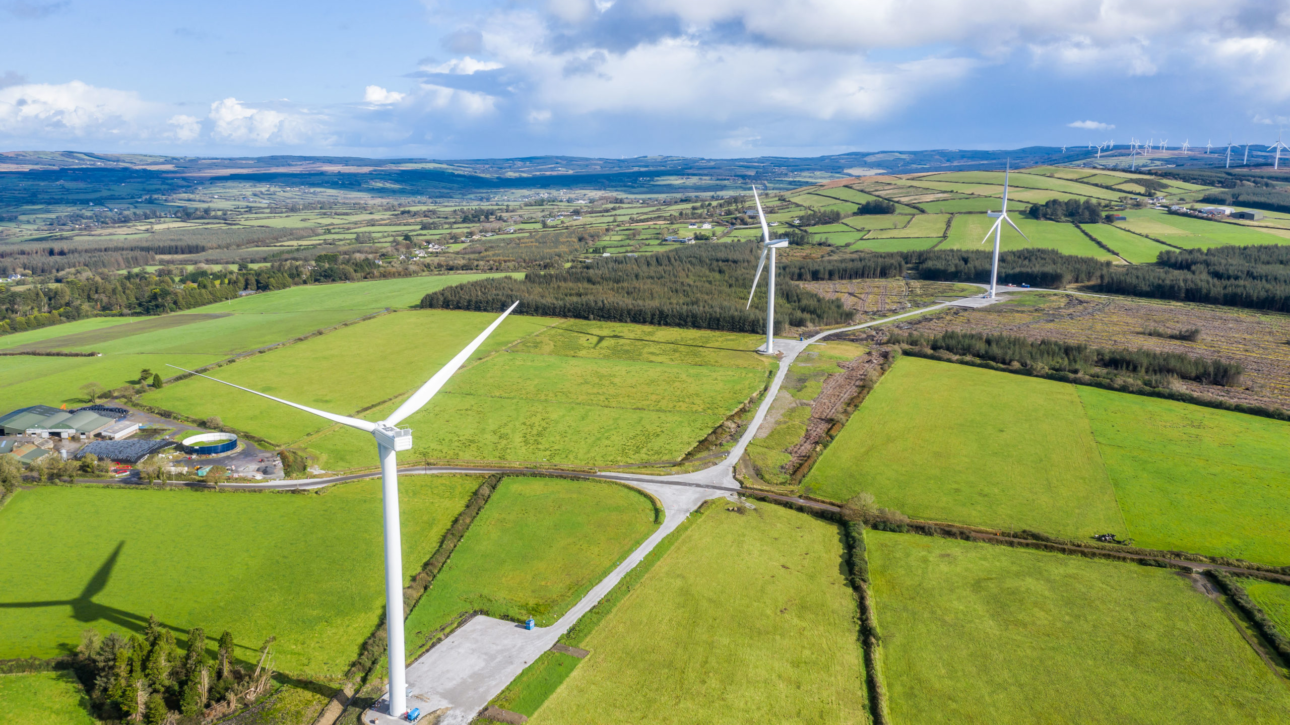
One of the clearest indicators of the rise of green finance is the rapid expansion of the global green bond market. Over the past decade, green bonds have evolved from a niche financing instrument into a mainstream component of sustainable capital markets, attracting increasing participation from governments, financial institutions, and corporate issuers worldwide.
The Origins of the Green Bond Market
Green bonds were first issued in the late 2000s by multilateral institutions such as the World Bank and the European Investment Bank. Their purpose was straightforward: to raise capital specifically earmarked for environmentally beneficial projects, including renewable energy infrastructure, energy efficiency upgrades, and climate-resilient urban development.
During the early years of the market, issuance volumes remained relatively modest. Green bonds were primarily issued by development institutions and a limited number of public-sector entities, reflecting the still-nascent stage of sustainable finance within global capital markets.
Acceleration in the 2010s
The market began to expand rapidly in the mid-2010s as sustainability considerations increasingly entered the strategic priorities of governments, corporations, and institutional investors. Climate policy commitments, particularly following the Paris Agreement in 2015, created strong incentives for public and private institutions to mobilise capital toward low-carbon investment.
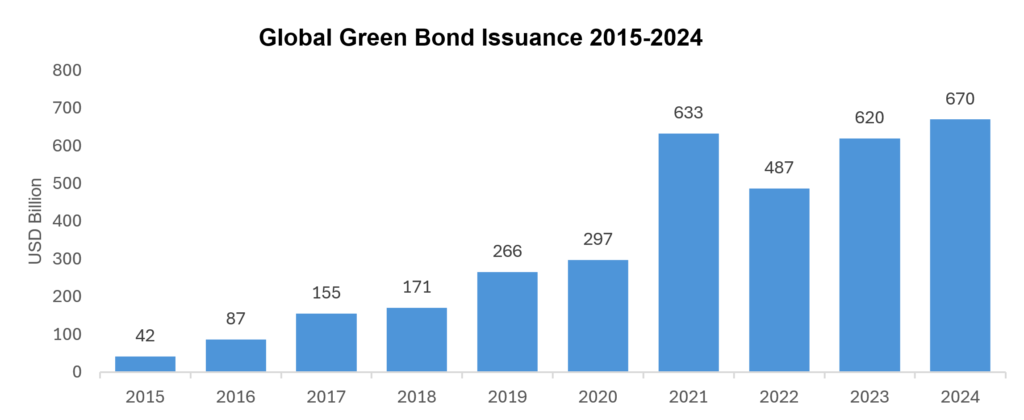
Source: Climate Bonds Initiative; LSEG Green Economy Report (2025).
As a result, global green bond issuance expanded from $42 billion in 2015 to $670 billion in 2024, representing more than a fifteen-fold increase within a single decade. This growth reflects not only rising investor demand for sustainable assets but also the increasing need for long-term financing of climate-related infrastructure and energy transition projects.
Structural Drivers of Market Growth
The trajectory of this expansion has not been perfectly linear. A major surge occurred in 2021, when issuance reached $633 billion, driven by post-pandemic recovery programs and large-scale climate investment commitments from both governments and corporations. Although global financial tightening led to a temporary slowdown in 2022, the market demonstrated resilience, with issuance rebounding to $620 billion in 2023 and $670 billion in 2024.
Several structural forces have contributed to this sustained momentum. Governments have strengthened climate policy frameworks and decarbonisation targets, creating clearer long-term investment signals. Institutional investors—including pension funds and asset managers—have increasingly integrated ESG considerations into portfolio allocation strategies. At the same time, corporations across energy, transportation, and infrastructure sectors have begun issuing green bonds to finance their decarbonisation roadmaps. Development banks and multilateral institutions have also played an important catalytic role by scaling blended finance structures that mobilise private capital toward climate-aligned projects.
Taken together, these dynamics have positioned green bonds as one of the most visible and rapidly expanding segments of global sustainable finance.
A Multi-Trillion Dollar Market in the Making
While green bonds often serve as the entry point to sustainable finance, the broader green finance ecosystem extends far beyond bond issuance. Over time, the market has expanded to encompass a diverse set of financial instruments designed to mobilise capital toward environmentally sustainable activities.
The Expanding Scope of Green Finance
Green finance today includes a wide spectrum of financial activities across both public and private markets. These range from sustainable infrastructure financing and renewable energy project funding to climate-aligned private equity investments, sustainability-linked corporate lending, and a growing universe of green investment funds and exchange-traded products.
As these instruments continue to proliferate across global capital markets, they are enabling financial institutions to channel capital toward projects that support the energy transition, environmental protection, and climate resilience. This diversification of financing channels has significantly broadened the scope of sustainable investment, transforming green finance from a niche funding mechanism into a more comprehensive financial ecosystem.
Market Scale and Capital Market Implications
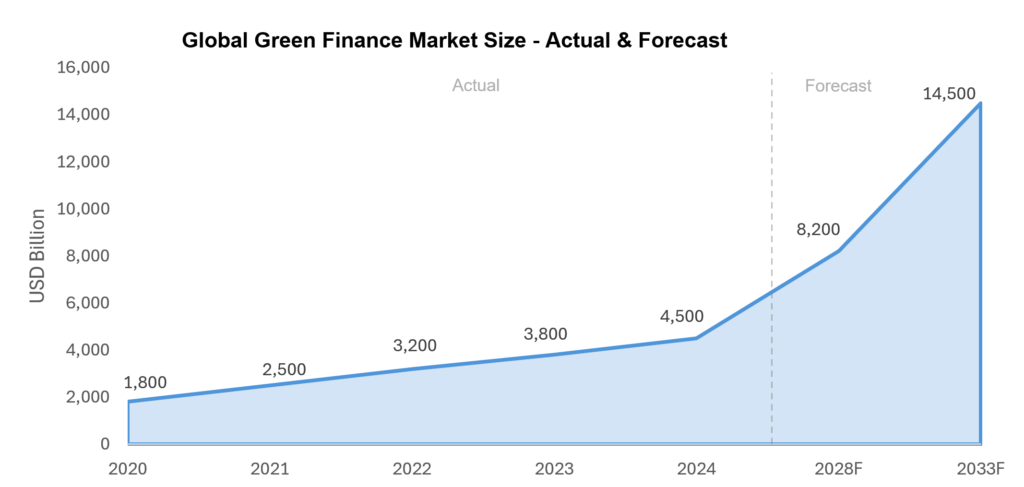
The rapid expansion of these instruments has been accompanied by strong growth in the overall size of the green finance market. The global market reached approximately $4.5 trillion in 2024, up from $1.8 trillion in 2020, reflecting accelerating capital flows toward climate-related investment opportunities.
Looking ahead, forecasts suggest continued strong expansion. The market could exceed $8.2 trillion by 2028 and is projected to reach approximately $14.5 trillion by 2033, implying a compound annual growth rate of roughly 12–16 percent. Such growth would place green finance among the fastest-expanding segments of the global financial system.
Source: Market Research Future; Credence Research (2025)
From a capital markets perspective, the implications are significant. Asset managers are increasingly structuring climate-aligned investment portfolios, banks are developing specialised green lending frameworks, and sovereign governments are issuing sustainability-linked debt instruments to finance national energy transition strategies. Taken together, these developments indicate that green finance is no longer merely a thematic investment trend but is gradually becoming an integral component of global financial architecture.
Financing the Energy Transition
The rapid expansion of green finance is closely tied to the scale of the global energy transition. As governments and industries attempt to shift the world’s energy systems away from fossil fuels, the transformation requires unprecedented levels of long-term capital investment across multiple sectors of the global economy.
The Scale of Capital Required for Energy Transition
Transforming global energy systems involves large-scale investment in renewable electricity generation, power grid modernisation, battery storage and electrification technologies, hydrogen infrastructure, and sustainable transport systems. These sectors require significant upfront capital expenditure, often with long investment horizons, making them particularly dependent on deep and well-functioning financial markets.
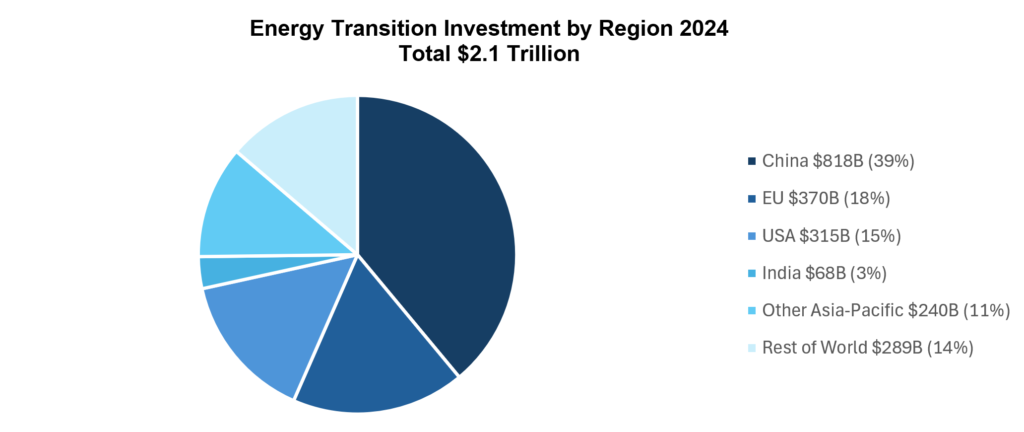
Recent estimates highlight the magnitude of this investment challenge. According to BloombergNEF, global energy transition investment reached approximately $2.1 trillion in 2024, reflecting accelerating capital flows toward renewable energy, electrification, and low-carbon infrastructure. Despite this rapid growth, current investment levels remain only a portion of what will ultimately be required to achieve long-term climate targets.
Regional Investment Dynamics
The distribution of global energy transition investment is also highly uneven across regions. China accounted for the largest share in 2024, with approximately $818 billion in investment, representing roughly 39 percent of the global total. The European Union followed with around $370 billion, while the United States invested approximately $315 billion in energy transition technologies.
Other Asia-Pacific economies collectively contributed roughly $240 billion, while the rest of the world accounted for approximately $289 billion in investment. These regional patterns reflect differences in industrial structure, policy frameworks, and capital market depth across major economies.
Source: BloombergNEF Energy Transition Investment Trends (Jan 2025)
Taken together, these figures highlight a critical reality: the global energy transition is not simply a technological challenge. It is fundamentally a capital allocation challenge. Achieving climate targets will require sustained investment flows over multiple decades, spanning public infrastructure spending, private capital markets, and multilateral development finance. Within this context, green finance provides the financial infrastructure through which these large-scale investments can be mobilised and deployed.
The Role of Capital Markets in Climate Transition
Historically, large-scale infrastructure transformations—such as the expansion of railways, telecommunications networks, and later the digital economy—have been made possible by deep and well-functioning capital markets capable of financing long-term investment. These structural shifts required substantial upfront capital and long investment horizons, conditions that typically depend on sophisticated financial systems to mobilise and allocate funding efficiently.
The global energy transition is likely to follow a similar trajectory. Public budgets alone cannot finance the trillions of dollars required to decarbonise energy systems worldwide. Instead, private capital markets will need to play a central role in funding renewable energy deployment, industrial transformation, and climate-resilient infrastructure.
In this context, green finance instruments increasingly act as a bridge between climate policy objectives and capital market mechanisms. By establishing transparent frameworks for climate-aligned investment, these instruments enable institutional investors to allocate capital toward environmental projects while maintaining financial discipline and return expectations.
This alignment between sustainability objectives and financial incentives is ultimately what allows green finance to scale. As sustainable capital markets continue to deepen, they have the potential to reshape how investment capital is allocated across industries and regions, gradually embedding climate considerations into the core architecture of global financial markets.
A Structural Shift in Global Finance
The rise of green finance signals a broader transformation within the global financial system. For decades, environmental considerations remained largely external to capital markets. Investment decisions were primarily driven by traditional financial metrics, while environmental impacts were often treated as secondary or non-financial concerns.
Today, that paradigm is gradually shifting. Climate risk is increasingly recognised as financial risk, influencing how investors assess long-term asset values, regulatory exposure, and systemic vulnerabilities. At the same time, the global transition toward a low-carbon economy is generating new investment opportunities across sectors such as renewable energy, infrastructure, advanced manufacturing, and clean technologies.
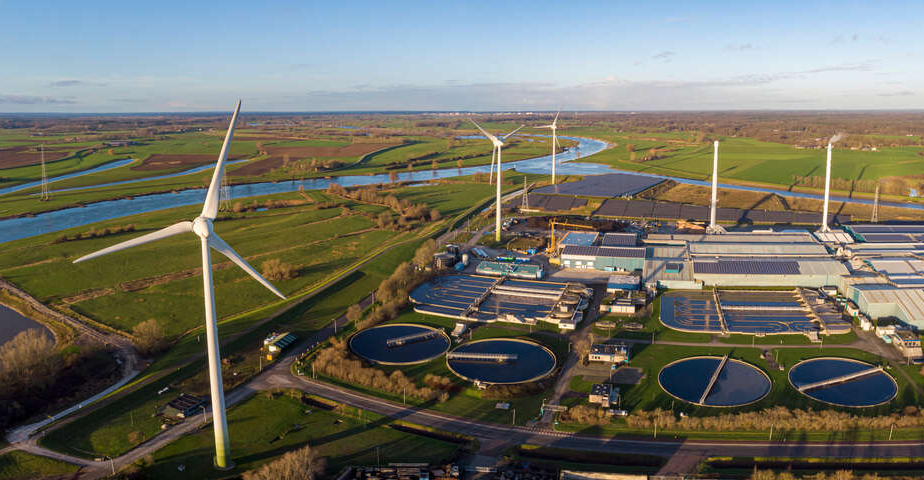
As a result, sustainability considerations are becoming more deeply embedded within financial regulation, institutional asset allocation strategies, and corporate financing decisions. These developments suggest that green finance is no longer simply an emerging investment theme but represents a structural evolution in the architecture of modern capital markets.
Looking ahead, the ability to mobilise and allocate climate-aligned capital efficiently may become a defining factor in both economic competitiveness and financial system resilience over the coming decades.
Conclusion
The rapid expansion of green finance reflects the growing intersection between climate policy, technological innovation, and global capital markets. From the surge in green bond issuance to the multi-trillion-dollar scale of energy transition investment, financial markets are increasingly shaping how the world funds its transition toward a lower-carbon economy.
For investors, financial institutions, and policymakers, understanding the dynamics of green finance is no longer optional—it is central to navigating the evolving landscape of global capital allocation. As the scale of the energy transition continues to grow, green finance is likely to remain one of the most important structural forces shaping international financial markets in the decades ahead.
For deeper insights on capital markets, infrastructure investment, and emerging market opportunities, follow Dealflow for research-driven perspectives on global finance via LinkedIn or explore more analysis at Dealflow.sg.