
Fountain Set (Holdings) Limited has agreed, through a subsidiary, to buy an 81% interest in a Vietnamese textile company for US$27.945 million. The buyer will keep back US$5.589 million, or 20% of the price, after closing. For a seller, that gap is the real question in any offer. The headline price is not the cash received at closing, and the retained part can shrink. In this deal, the answer sits in five release conditions. Each one covers a risk the buyer cannot fully check before it takes control. Reading M&A holdbacks this way shows what a headline price is worth.
The Buyer Is Acquiring a Company Emptied of Its Old Assets and Debts
The purchaser is Ocean Textile Investment Pte. Limited, a Singapore company indirectly wholly owned by Hong Kong-listed Fountain Set (Holdings) Limited. The vendor is Lian-Ta-Hsing International Co., Ltd., a Seychelles holding company that owns all of the target today. The target is Lian-Ta-Hsing (Vietnam) Co., Ltd., a knitting, dyeing and finishing business in Tay Ninh Province. After completion, a minority shareholder designated by the vendor and approved by the purchaser will hold the other 19%.
Before the sale, the vendor had to strip out the target’s working assets and debts as at 30 April 2026. About HK$58.3 million of cash, receivables and inventory left the company, along with about HK$62.5 million of liabilities. The price is fixed, with no working capital adjustment. The target also reported losses in 2024, 2025 and early 2026.
The agreement was signed on 9 September 2026. Shareholders approved it on 29 October. As of 12 November, HKEX shows no completion announcement. The circular expected completion around March 2027. With no price adjustment, the retention does much of the protective work that M&A holdbacks are designed for.
The Agreed Price Is Payable in Three Stages
The headline price arrives in three parts. Two of them are paid by closing.
The initial instalment of US$5.589 million (20%) is payable once the agreement takes effect and the vendor and minority shareholder have completed their internal approvals. It had not been paid as of 25 September 2026. The vendor must return it within five working days if the deal fails on its conditions, unless the purchaser is at fault.
The completion payment of US$16.767 million (60%) is due at closing. It depends on registration of the new ownership, transfer of management control and proof that the vendor’s transfer taxes have been declared and paid. None of these conditions had been met as of 25 September either.
By closing, the vendor can therefore receive up to US$22.356 million gross. Tax reduces the direct receipt. The circular estimates the vendor’s capital transfer income tax at US$558,900, which the purchaser may withhold from the first instalment. On that estimate, US$5,030,100 of it would reach the vendor directly.
The final US$5.589 million (20%) is the retention amount. The purchaser holds it after closing.
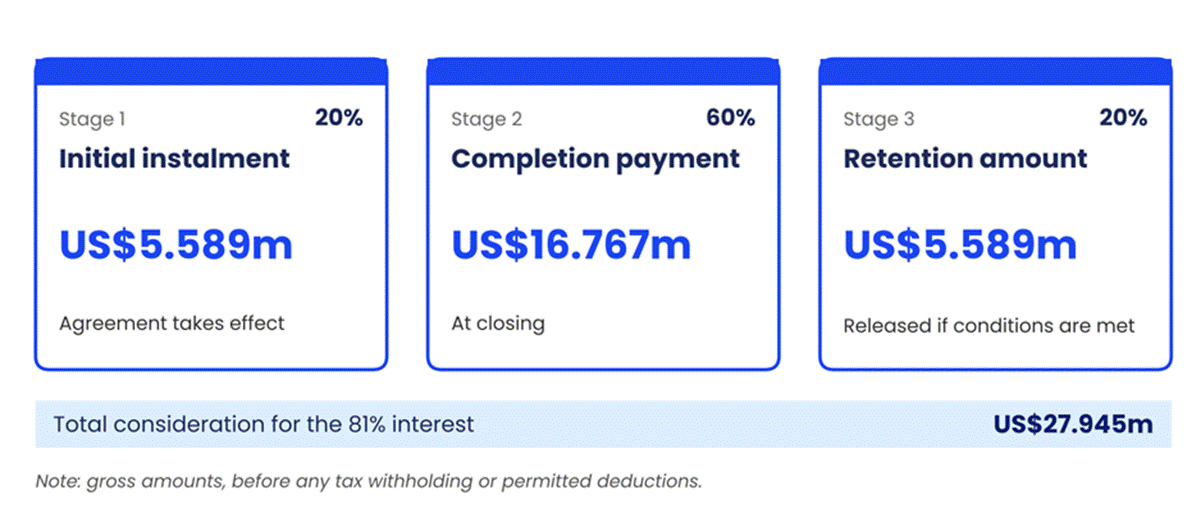
Figure 1: Fountain Set’s proposed acquisition consideration is split across three payment stages (Source: Fountain Set (Holdings) Limited).
The Final Payment Waits Until the Buyer’s Main Risks Are Cleared
The circular names four things the retention secures. They are the target’s refund of prepaid rent, historical liabilities from before completion, outstanding divestment matters and the vendor’s indemnities, meaning its promises to compensate the buyer for specified problems. The money is released only when all five conditions are met. If any condition fails, the purchaser may withhold all or part of it without breach.

DealFlow analysis: each condition answers a specific buyer risk.
- At least six months have passed since completion. Some problems appear only once a buyer controls the books. The six months gives it time to find them.
- The purchaser and minority shareholder have made proportionate shareholder loans to the target. The target’s cash was removed in the divestment, so it needs these loans to fund the rent refund.
- The target has repaid the prepaid rent in full, and Fountain Set Limited has confirmed receipt. Fountain Set Limited, another subsidiary of the listed parent, rented equipment and facilities from the target and prepaid the rent. The lease ends at completion, so the target must pay it back.
- Fountain Set Limited has issued a debt settlement and release confirmation acceptable to the purchaser. This closes off any further claims under the lease.
- No unresolved historical liabilities, undisclosed tax, labour claims, penalties or disputes have surfaced in those six months. These would be debts from the vendor’s period that the buyer did not agree to take on.
Conditions 2 to 4 mostly move a debt within the buyer’s group. Conditions 1 and 5 are where the vendor carries real risk.
Separately, the buyer may deduct two kinds of amounts before release. One is any shortfall from the divestment, which the vendor must make good in cash. The other is any claim under the vendor’s indemnities. Deducting from money it already holds is easier for the buyer than claiming from the vendor after payment.
A ten-year personal guarantee from Kao Wen-cheng, the guarantor named in the agreement, adds a second layer for larger or later claims.
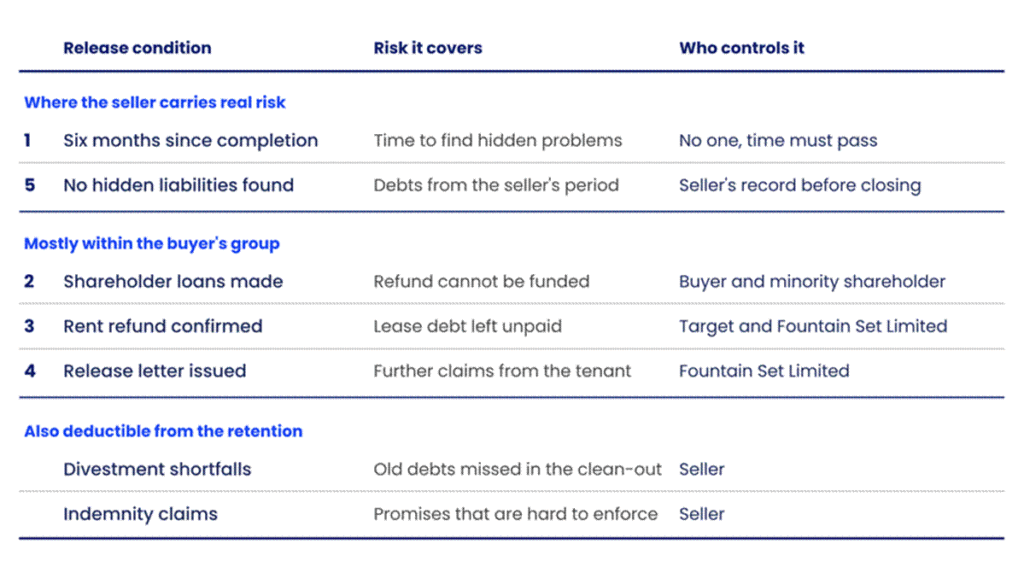
Figure 2: Each of the five release conditions covers a specific buyer risk and depends on different parties (Source: Fountain Set (Holdings) Limited, DealFlow analysis).
Conditional Payments Change the Economics of Competing Offers
A purchase price holdback and an earn-out both defer part of the price, but they do different jobs. A holdback secures obligations the seller already carries. An earn-out pays more if the business performs. Escrow differs again, because an independent agent holds the funds rather than the buyer.
For a seller, four questions decide what a conditional amount is worth:
- How much is paid directly at closing?
- How long until the expected release?
- What can the buyer deduct, and on what evidence?
- Who controls each release condition?
Two offers with the same headline price can therefore carry different expected seller proceeds. A longer wait lowers present value. Wider deduction rights lower the amount likely to be collected. Conditions held by the buyer add uncertainty the seller cannot manage. In this deal, three of the five conditions depend mainly on the buyer’s own group.
The release test matters too. A fixed date or an objective document is easier to rely on than one the buyer must find acceptable, as condition 4 requires here.
Release Conditions Determine What the Seller Can Count On
This Vietnam acquisition shows the seller’s exposure in four parts: what is held, when it may be released, what can be deducted and whose actions are required. The vendor can receive up to US$22.356 million gross by closing. The final US$5.589 million waits at least six months and depends partly on parties the vendor does not control.
The lease and shareholder loans are specific to this deal. The lesson is broader. M&A holdbacks are best read as a list of buyer risks with a price attached. Each condition shows what the buyer fears it cannot see before closing. A seller who reduces those risks early, through clean records and a complete pre-sale clean-out, gives the buyer less reason to hold money back. Sellers should map each condition to a responsible party and a date before comparing M&A payment terms.
DealFlow’s M&A advisory services include deal structuring and transaction support. If you are weighing a proposed sale, our team can review the valuation together with the payment schedule, retention conditions and deduction rights. Contact DealFlow to discuss how an offer’s structure may affect what you ultimately receive.